
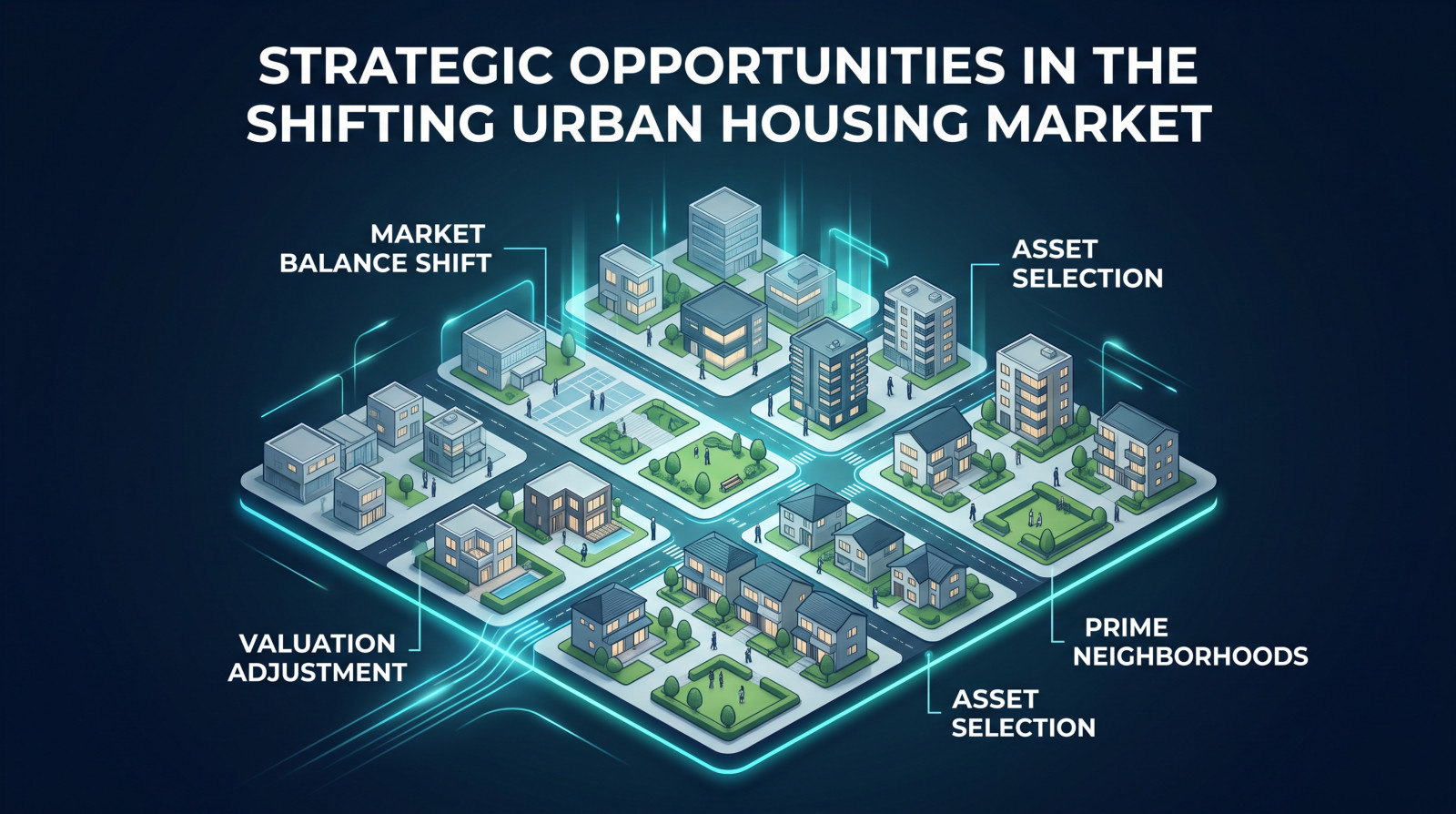
The Turning Point in Tokyo Prime Residential Real Estate
For more than a decade, the central Tokyo condominium market moved in an almost uninterrupted upward trajectory. Pushed by ultra-loose monetary frameworks, intense domestic demand for luxury tower mansions, and robust international interest, prime central wards—specifically Minato, Chiyoda, Shibuya, Shinjuku, and Chuo—saw values double and in select premier developments, nearly triple.
However, the macro environment has entered a decisive shift. The market has begun navigating a distinct price adjustment phase. Driven by rising interest rates engineered by the Bank of Japan, real estate valuations across Tokyo are transitioning from speculative euphoria toward strict yield-driven fundamentals. For cross-border investors, this inflection point signals an essential recalibration: the era of buying indiscriminately for capital gains has closed, giving way to a discerning buyer's market where sophisticated analysis uncovers exceptional long-term intrinsic value.
Understanding the dynamics behind this transition—especially the widening gap between asking and closing prices—is paramount to identifying the real opportunities now emerging across Japan's leading metropolitan centers.
Catalysts of the Price Adjustment Phase
Several macroeconomic and demographic forces have converged to produce the current normalization in residential pricing.
1. Macro Policy Normalization and Rising Interest Rates
The central bank's sustained exit from negative rate experiments represents the fundamental driver of market sentiment. Although Japanese sovereign and benchmark rates remain exceptionally low relative to North American and European equivalents, the psychological and operational impact of rising interest rates cannot be overstated.
Domestic household purchasing capacity has plateaued. For years, domestic buyers stretched their affordability limits on high-rise condominiums under virtually cost-free conditions. As benchmark yields rise, affordability equations tighten, directly curbing the bidding wars that defined prime Tokyo sales over recent years.
2. Widening Gap Between Asking and Closing Prices
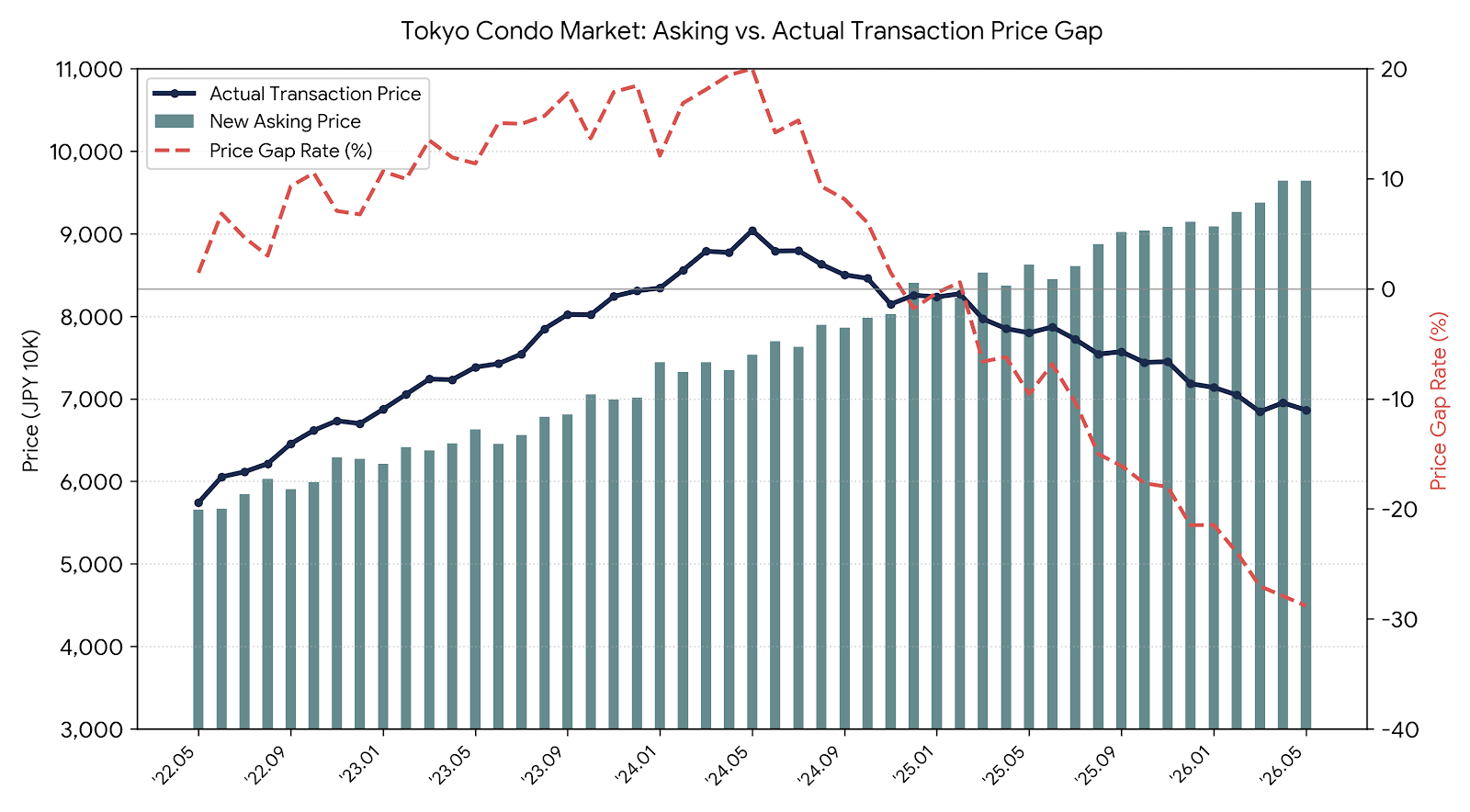
A hallmark of any late-cycle transition is the bid-ask spread. Over the past twelve months, portal asking prices have maintained aggressive historical peaks, yet executed transactions reveal an expanding divergence.
- Sellers' Perspective: Domestic individual owners and speculative developers, anchored by peak benchmark transactions, continue listing prime units at premium figures.
- Buyers' Stance: Institutional funds and informed individual buyers systematically discount asset values to reflect rising discount rates and desired operational margins.
- The Result: Properties sit on the market significantly longer. Average marketing periods in central Tokyo have extended from 45 days to well over 110 days for properties positioned above realistic valuation metrics.
This gap between asking and closing prices represents the exact window where skilled international buyers negotiate realistic discounts that were impossible to secure during the frenzy of the preceding five years.
3. Construction Cost Normalization vs. Resale Inventory
While new-build condominium supply costs remain elevated due to material imports, energy expenses, and labor constraints under updated construction overtime regulations, the existing (resale) market is diverging. Discerning purchasers increasingly prioritize structurally sound, well-managed secondary properties where the replacement premium has decoupled from seller expectations.
Market Realities by District: Central Tokyo Performance Metrics
To contextualize how the adjustment unfolds geographically, the following table illustrates the recent behavioral divergence across key urban centers:
| Ward / Sub-Market | Asset Profile | Asking Price Trend | Closing Price Reality | Typical Discount Range | Primary Buyer Driver |
|---|---|---|---|---|---|
| Minato Ward (Roppongi, Akasaka) | Luxury High-Rise (>80 sqm) | Flat to Slight Peak | Modest Compression (-3% to -5%) | 4% – 8% | International Capital & Wealth Preservation |
| Chiyoda Ward (Bancho, Kudan) | Ultra-Prime Heritage Resale | Sustained / Inelastic | Resilient (-1% to -3%) | 2% – 5% | Domestic Generational Wealth |
| Shibuya Ward (Ebisu, Hiroo) | Boutique Mid-Rise (40–65 sqm) | Softening (-2%) | Correcting (-5% to -8%) | 6% – 10% | Affluent Professionals & Yield Seekers |
| Chuo Ward (Kachidoki, Harumi) | Large-Scale Waterfront Towers | Volatile Listings | Significant Gap (-8% to -12%) | 8% – 14% | Domestic Families & Upgraders |
| Shinjuku Ward (Nishi-Shinjuku) | Mixed Commercial-Residential | Moderate Adjustment | Stabilizing (-4% to -6%) | 5% – 9% | Corporate Tenancies & Foreign Investors |
Investors evaluating portfolio opportunities can examine active listings matching these operational metrics via Property Listings.
Identifying the "True Investment Opportunity"
Market corrections often cause inexperienced market participants to withdraw, misinterpreting stabilization as systemic distress. Conversely, seasoned global allocators recognize that a cooling market removes speculative noise, exposes motivated sellers, and rewards disciplined selection.
1. Acquiring Prime Real Estate at Justified Yields
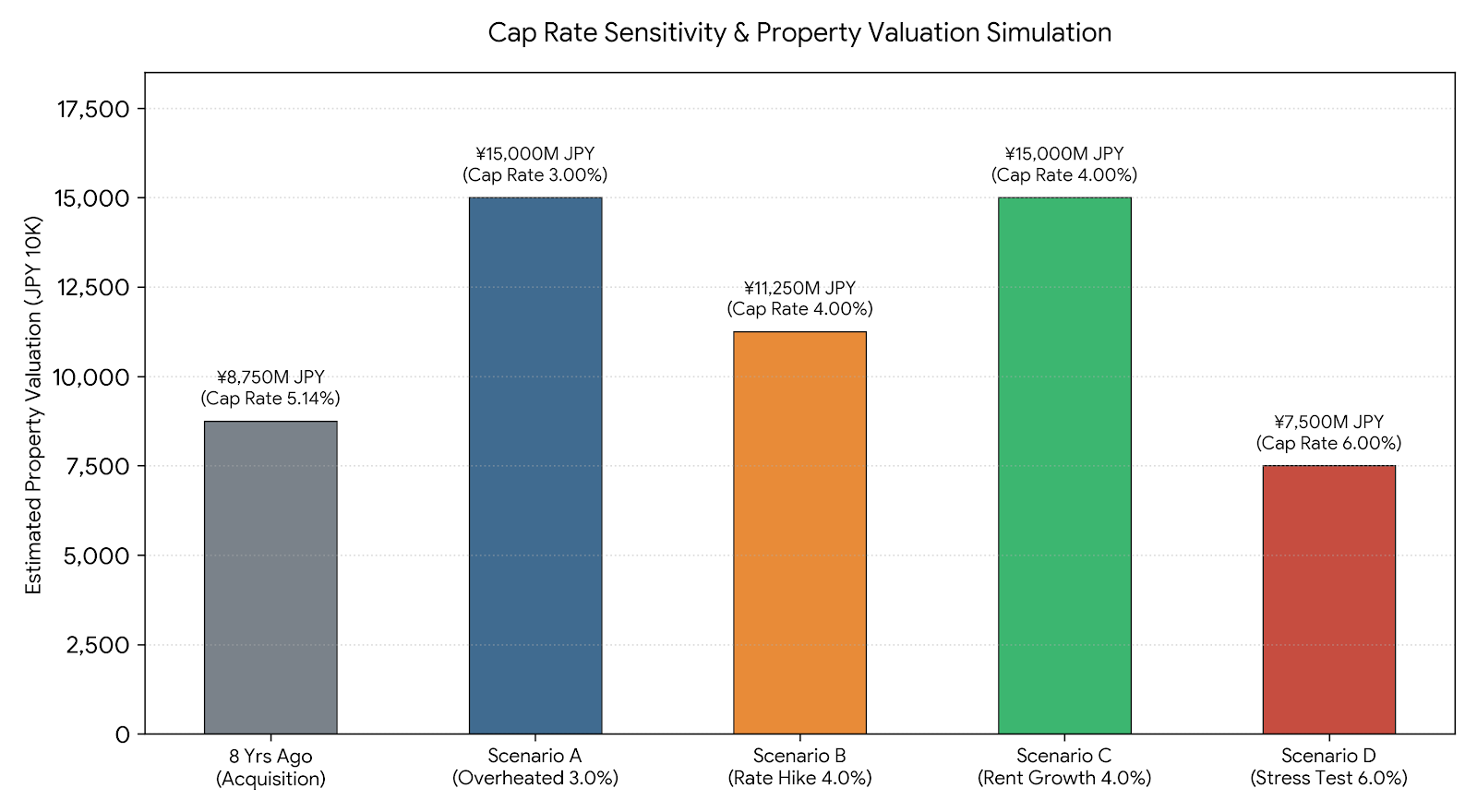
During the peak cycle, net capitalization rates for prime central Tokyo apartments compressed to historic lows of 2.5% to 2.9%—levels that left zero margin for operational error or market fluctuations. Today's correction enables international buyers to acquire institutional-grade assets in established neighborhoods at stabilized yields closer to 3.8% to 4.5% net, backed by inflation-adjusted urban wage increases that support steady rental appreciation.
2. Motivated Seller Dynamics
With properties lingering on the secondary market, three classes of domestic sellers are demonstrating real flexibility:
- Corporate Holdings Divesting Non-Core Assets: Japanese small-to-mid enterprises holding residential real estate on balance sheets are actively trimming non-operating inventory ahead of balance sheet audits.
- Inheritance Estate Liquidations: Inheritors facing Japan’s strict ten-month statutory inheritance tax deadline are increasingly willing to accept realistic offers rather than gamble on protracted listing timelines.
- Individual Relocations and Trade-Downs: Owners who bought early in the previous decade are sitting on substantial unrealized gains; accepting an 8% to 10% discount below the theoretical peak still delivers an enviable historical return.
3. Flight to Structural Quality and Governance
Not all condominiums adjust equally. The market is dividing strictly into two tiers: properties with exemplary building management, robust long-term repair reserves (shuzen tsumitatekin), and prime transit connectivity vs. aging, sub-scale buildings facing deferred maintenance shortfalls.
International buyers targeting properties constructed under the modern anti-seismic code (Shin-Taishin, enforced post-1981) with impeccably managed homeowner associations (kanri kumiai) can secure generational assets that defend capital across all stages of economic cycles.
Cultural Nuances: Overcoming Barriers in a Changing Japanese Market
Investing in Japanese real estate involves navigating unique commercial customs, communication expectations, and structural mechanisms that directly impact negotiation outcomes.
The Anatomy of Price Negotiations (Nebiki)
In Western real estate markets, opening negotiations with aggressive, low-ball bids (e.g., 20% to 30% below asking) is standard commercial posturing. In Japan, this approach frequently backfires entirely.
- Relationship and Sincerity (Seijitsusa): Japanese sellers and their brokerages place immense value on transaction certainty and mutual respect. An excessively aggressive opening offer may be interpreted as an insult or a sign of an untrustworthy counterparty, leading the seller's representative to terminate talks outright.
- The Structured Bid: In the current price adjustment phase, realistic discount requests backed by comparable sales data, immediate closing capability, and clear documentation of commitment receive earnest consideration. A counteroffer requesting a 5% to 9% adjustment accompanied by an unconditioned Letter of Intent (Kaitotsu Negai) is far more effective than an arbitrary low bid.
Due Diligence on Association Health and Maintenance Reserves
In Japanese condominium ownership, the quality of building governance is as vital as physical location. Every investor must scrutinize two key documents before proceeding:
- The Important Matters Investigation Report (Chosa Hokokusho): Details the exact financial reserves of the building management association, historical repairs completed, planned major exterior refurbishments, and any default rates among existing owners.
- Long-Term Repair Plan (Choki Shuzen Keikaku): Identifies whether the building faces an upcoming shortfall in reserve funds that might prompt sudden increases in monthly maintenance levies.
During a market cooling period, buildings with underfunded reserves see values fall much faster than properties with disciplined, well-capitalized associations.
Risk Factors to Evaluate Diligently
While the current cycle provides compelling entry points, foreign investors must factor specific structural risks into their acquisition models:
1. Demographic Divergence Across Wards
Japan’s aggregate population is declining, but central Tokyo remains a prominent exception, drawing ongoing domestic and foreign net migration. However, outer suburbs and non-core wards (such as Adachi, Katsushika, and peripheral parts of Edogawa) do not share central Tokyo’s fundamental resilience. Allocators must avoid confusing outer-ring high nominal yields with real total return; yield expansion in peripheral areas often conceals terminal capital depreciation and extended vacancy durations.
2. Tax Realities and Holding Periods
Foreign purchasers must design their investment horizon with Japan’s capital gains tax distinctions in mind:
- Short-Term Capital Gains: Real estate held for 5 years or less (measured as of January 1 of the sale year) is subject to significantly higher national and local capital gains rates.
- Long-Term Capital Gains: Real estate held for more than 5 years benefits from substantially reduced tax rates.
Consequently, the Japanese market rewards medium-to-long-term strategic accumulators over short-term flippers.
3. Currency Volatility Dynamics
While exchange rate movements present attractive purchasing parity for international asset owners, currency trends cut both ways over a multi-year horizon. Underwriting should never rely exclusively on foreign exchange appreciation to manufacture acceptable returns. The underlying property must stand on its own merits: solid location, dependable local occupancy demand, strong physical governance, and defensive cash flow.
Explore vetted investment opportunities featuring transparent management records through our curated Property Listings.
Strategic Playbook for Foreign Buyers
To maximize value during this pivotal market phase, prospective buyers should deploy a methodical execution strategy:
- Focus on Undisputed Micro-Locations: Prioritize properties situated within a 7-minute walking radius of major Tokyo Metro or JR transit lines within the core central wards. Connectivity remains Tokyo’s strongest defense against economic cyclicality.
- Target Mispriced Resale Units Over Speculative Pre-Constructions: Resale properties in completed, top-tier complexes allow immediate verification of construction quality, community governance, tenant demographics, and realized historical yield.
- Leverage Time-on-Market Analytics: Direct attention toward properties that have crossed the 90-day listing mark. Sellers at this stage are significantly more receptive to realistic closing valuations than those newly hitting the market.
- Work with Bilingual Representation Well-Versed in Local Protocol: Navigating the subtle etiquette of Japanese broker-to-broker networks ensures foreign buyers are presented as preferred, reliable partners rather than uncertain international risks.
Conclusion: Capitalizing on the Market Shift
The transformation underway across Tokyo’s prime condominium sector marks the return of rationality, discipline, and sustainable investment fundamentals. As the price adjustment phase deepens and the gap between asking and closing prices clarifies true market clearing levels, the environment shifts decisively in favor of well-prepared international allocators. By focusing on asset quality, understanding local negotiation customs, and insisting on rigorous operational metrics, global investors can establish resilient, prime Tokyo real estate portfolios positioned for long-term capital stability.