

Overview of the Tokyo 23 Wards Detached Housing Market
Recent market data indicates that the average price of newly built detached houses across Tokyo's 23 special wards surpassed 130 million yen, maintaining record levels for two consecutive months. This upward trajectory reflects a structural shift in the capital's housing sector, influenced by increasing land acquisition costs, elevated building material expenditures, and broader developments within central Tokyo apartment pricing.
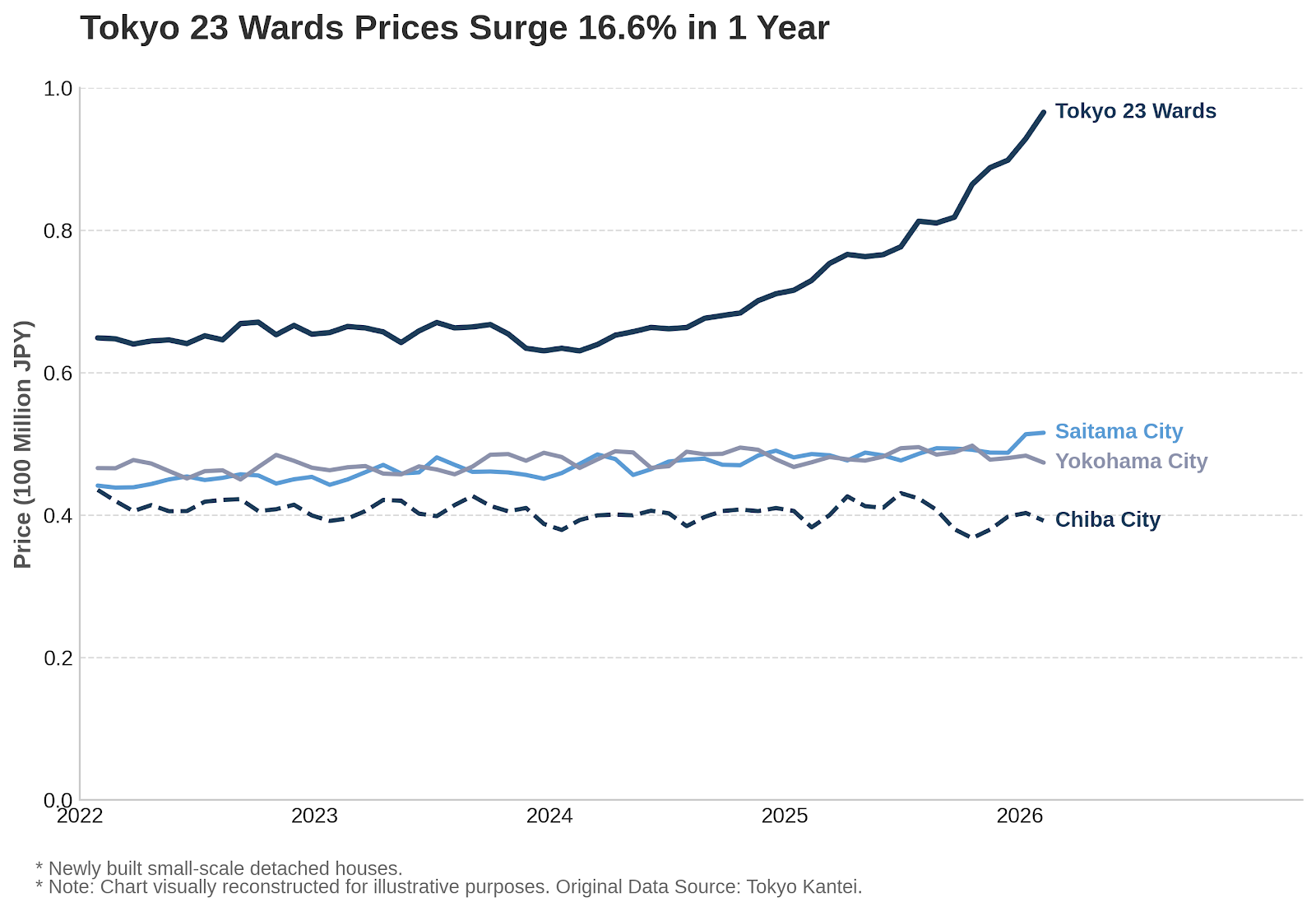
While central apartment units have historically absorbed strong cross-border and domestic interest, standalone homes are increasingly entering the spotlight. International investors monitoring Tokyo real estate should examine the underlying fundamentals driving this movement, especially the transition of actual residential demand from apartments to detached houses.
Investors can review current market opportunities through Property Listings.
Data Analysis: Price Movement and Regional Comparisons
Market indices compiled across Greater Tokyo show clear divergence among property formats and administrative boundaries. The price gains in detached residences demonstrate distinct geographical concentration.
Price Milestones in Tokyo 23 Wards
| Region / Ward Cluster | Average Price Range (JPY) | Average Land Area (sqm) | Average Floor Area (sqm) |
|---|---|---|---|
| Central 6 Wards (Chiyoda, Chuo, Minato, Shinjuku, Shibuya, Bunkyo) | 160,000,000 - 240,000,000 | 60 - 85 | 95 - 125 |
| Western / Southern Inner Wards (Meguro, Setagaya, Shinagawa, Ota) | 120,000,000 - 165,000,000 | 70 - 100 | 90 - 120 |
| Northern / Eastern Wards (Koto, Suginami, Nakano, Nerima) | 90,000,000 - 125,000,000 | 80 - 110 | 85 - 115 |
| Suburban Outlying Wards (Adachi, Katsushika, Edogawa, Itabashi) | 65,000,000 - 85,000,000 | 75 - 105 | 80 - 105 |
The monthly data reveals that supply shortages in central areas have pushed the regional average past 130 million yen. Developers are contending with rising construction costs, which have grown consistently due to import prices for lumber and steel, coupled with revised labor regulations restricting overtime work for construction personnel.
Drivers Behind the Growth: Condominium Surge and Actual Residential Demand
Two central factors account for the pricing records in Tokyo detached homes:
1. Surging Central Condominium Prices
New condominium units in central Tokyo have seen average unit prices cross 100 million yen, with central districts frequently reporting unit averages above 150 million yen. For domestic households seeking 70 to 80 square meters of living space, central apartment units have become cost-prohibitive. Consequently, buyers with actual residential demand (actual owner-occupiers rather than speculative buyers) have shifted focus toward detached homes, which offer comparable or larger floor areas along with ownership of the underlying land plot.
2. Land Ownership Appeal and Management Independence
A detached home conveys full ownership rights to both the structure and the physical land parcel underneath (under standard ownership titles, or shoyuken). Unlike condominium units, detached properties do not require monthly management fees (kanrihi) or mandatory repair reserve funds (shuzen tsumitatekin). As condominium management charges rise across Japan to account for maintenance inflation, the absence of ongoing building association assessments provides cost predictability for residents and property owners.
Key Characteristics of Tokyo Detached Houses
Detached housing in urban Tokyo differs significantly from suburban properties in Western markets. Understanding these physical and legal characteristics is critical for international property buyers:
- Three-Story Wood-Frame Construction (Zairai Jiku-gumi): Due to strict plot ratios and small land dimensions, the majority of newly built urban homes are three-story timber-frame structures engineered according to the latest seismic safety standards established under the Building Standards Act (Kenchiku Kijun-ho).
- Strict Zoning and Sunshine Regulations: Tokyo enforces detailed building envelope rules, including setback lines (doro shasen seigen) and north-side shadow restrictions (kitagawa shasen seigen). These regulations directly dictate roof angles, floor heights, and structural designs to ensure neighboring plots maintain access to natural light.
- Fire Prevention Standards: Dense residential zones are classified as Quasi-Fire Prevention Districts (Junkoboka Chiiki), requiring fire-resistant exterior walls, specialized window assemblies, and rated internal partitions.
Strategic Considerations for Overseas Investors
International investors assessing Tokyo's residential sector must evaluate detached properties through a specialized framework:
Rental Yields and Tenant Profiles
Detached homes in central and inner-suburban Tokyo typically attract corporate expatriates, diplomatic staff, and domestic dual-income professional families. Typical gross rental yields for newly built detached properties in the 23 wards range from 3.5% to 4.5%, depending on walking distance to the nearest train station. While condominium units often yield slightly lower percentages in central wards, detached homes benefit from longer average lease durations, as families move less frequently than single occupants.
Land Value Retention vs. Structural Depreciation
Under Japanese statutory taxation guidelines, wooden residential structures depreciate over an official useful life of 22 years. However, in urban Tokyo, land constitutes a major portion of the total property valuation—often between 60% and 75% of the total acquisition price in desirable wards. This means that even as the building structure depreciates on paper, the underlying land value provides asset stability.
Detached Property Valuation Structure (Tokyo 23 Wards):
+-------------------------------------------------------------+
| Land Component (60% - 75% of Total Acquisition Value)        |
| -> Subject to urban land supply constraints and price trends |
+-------------------------------------------------------------+
| Building Component (25% - 40% of Total Acquisition Value)    |
| -> Subject to statutory tax depreciation (22-year scale)     |
+-------------------------------------------------------------+
Maintenance and Facility Management
Unlike an apartment unit where an exterior management company oversees common corridors, roofs, and elevators, a detached homeowner holds direct responsibility for property maintenance. Overseas owners must contract with local property management firms capable of handling regular exterior inspections, drainage maintenance, and tenant communication.
Explore available detached residential options across central and suburban districts in Property Listings.
Market Outlook
With new condominium developments in central Tokyo continuing to command elevated price levels, demand for newly built detached properties across the 23 wards is expected to remain stable. Limited residential land release in areas within a 10-minute walk of major transit lines continues to constrain new supply. Investors seeking residential assets with direct land allocation should closely monitor ward-level price data and infrastructure developments across Tokyo's transit corridors.