
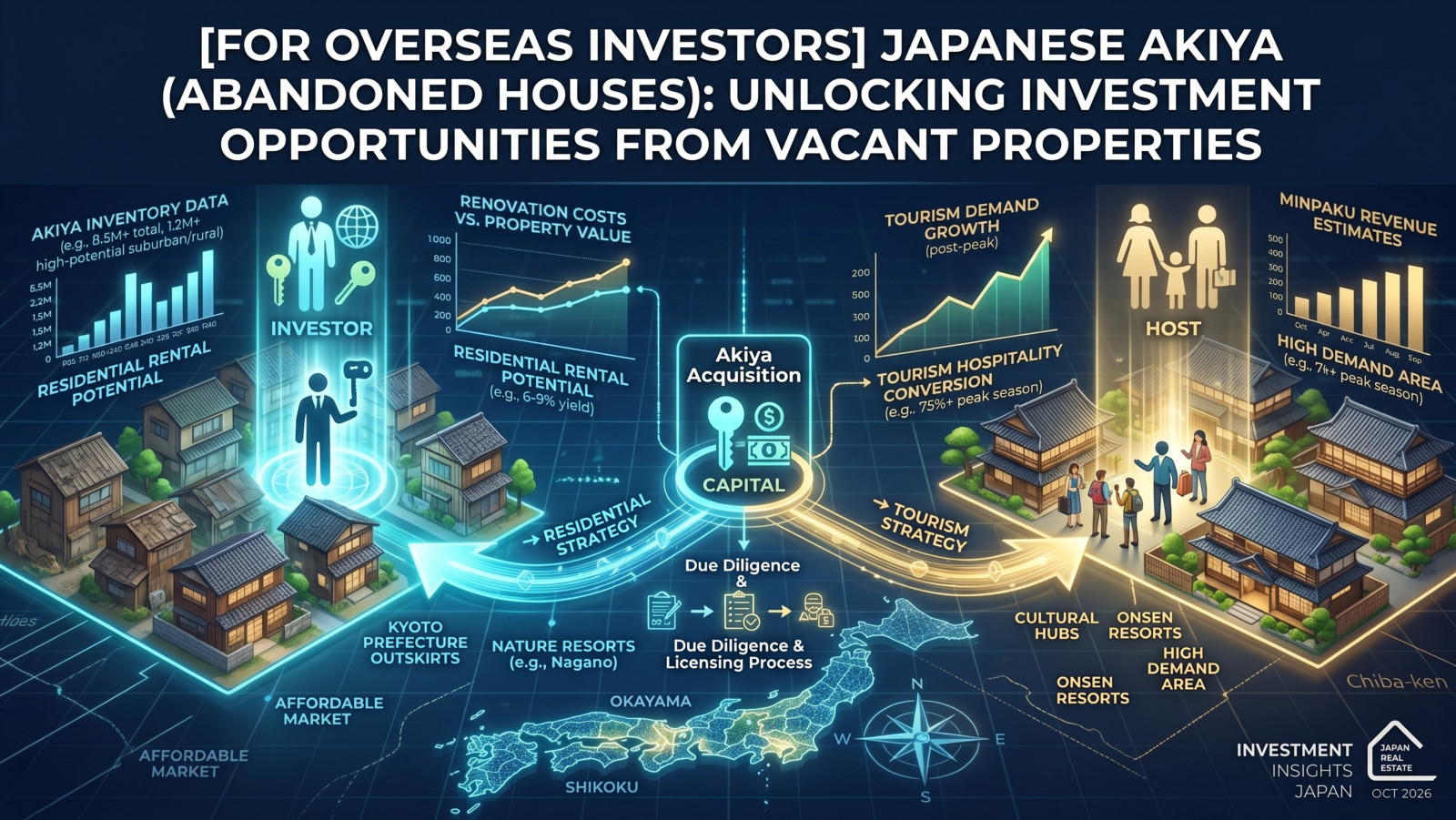
Understanding the Japanese Akiya Phenomenon
Japan faces an unprecedented demographic landscape characterized by a shrinking population and rapid urbanization. As younger generations migrate to major metropolitan centers such as Tokyo and Osaka, regional towns, suburban districts, and rural villages experience depopulation. A direct consequence of this shift is the proliferation of akiya (空き家)—unoccupied residential dwellings left behind by aging homeowners.
According to the 2023 Housing and Land Survey conducted by the Ministry of Internal Affairs and Communications (released in 2024), vacant houses in Japan reached approximately 9 million units, accounting for roughly 13.8 percent of the country's total housing stock. This structural surplus represents one of the most distinctive real estate landscapes among developed nations, creating unconventional avenues for foreign buyers seeking low-cost real estate investment opportunities outside traditional urban condominiums.
For non-resident investors looking beyond standard high-density apartment blocks, akiya properties present an intriguing entry point. However, transforming a vacant countryside or suburban home into a functional, revenue-generating asset requires a clear understanding of Japanese legal frameworks, structural considerations, and local community dynamics.
Why Overseas Investors Are Looking at Abandoned Japanese Homes
Interest from international buyers has surged as global property prices in gateway cities continue to climb. Japan stands out internationally due to its stable legal environment, transparent property rights, and absence of legal restrictions on foreign land ownership. Non-residents can purchase freehold title to land and buildings under the same legal principles as domestic citizens.
Low Initial Acquisition Outlays
Unlike metropolitan real estate in central Tokyo, where land prices have maintained an upward trajectory, rural and suburban homes can often be purchased for nominal sums. Many regional municipalities maintain public databases known as Akiya Banks (空き家バンク) to connect owners eager to offload unmaintained properties with prospective buyers interested in revitalization.
These low entry barriers allow foreign investors to allocate capital primarily toward thoughtful architectural restoration, modern thermal insulation, and interior redesign rather than land acquisition. To review the broad spectrum of traditional and modern properties currently available, visit Property Listings.
Architectural Value and Cultural Appeal
Many older dwellings, particularly traditional timber-framed houses (kominka), feature craftsmanship, mortise-and-tenon woodwork (tsugite), and local materials such as cedar and cypress that are cost-prohibitive to replicate today. For lifestyle investors and creative entrepreneurs, salvaging these homes offers cultural and aesthetic fulfillment that cannot be matched by contemporary prefabricated structures.
Primary Investment Models for Akiya Properties
Navigating an akiya investment successfully depends on selecting an operational model suited to the property's location, structural condition, and target demographic. Two strategic frameworks dominate the landscape: long-term residential leasing and hybrid vacation rental operations.
| Strategy | Target Audience | Regulatory Consideration | Key Operational Focus | | :--- | :--- | :--- | :--- | :--- | | Long-Term Residential Leasing | Local families, remote workers, retirees | Standard Lease Contract under the Act on Land and Building Leases | Durable modern amenities, energy efficiency, long-term tenant stability | | Hybrid Vacation Home (Minpaku) | Inbound tourists, domestic weekend travelers, owners | Private Lodging Business Act (180-day annual cap) | Tourism connectivity, self-check-in technology, professional housekeeping |
Strategy 1: Long-Term Residential Leasing
Transforming an unoccupied house into a stable residential rental property is a straightforward pathway for overseas owners seeking recurring income without the volatility of tourist cycles.
Identifying Local Tenant Demand
Not all regional areas have demand for rental housing. To succeed with a long-term rental strategy, focus on properties situated within commuting distance of:
- Regional hub cities and prefectural capitals
- Industrial zones, logistics centers, or manufacturing clusters
- Hospitals, regional university campuses, or research centers
- Train stations on active arterial transit lines
Young families and contract professionals in regional areas often look for detached single-family homes that offer garden space, parking for multiple vehicles, and privacy—features rarely available in standard suburban apartment complexes.
Renovation Realities and Cost Controls
Renovating an aging house requires disciplined project management. Typical priorities include:
- Plumbing and Water Infrastructure: Replacing deteriorated galvanized pipes with modern cross-linked polyethylene piping to prevent leaks.
- Wet Areas: Updating traditional tiled bathrooms (zairai-furo) to modular system baths, replacing squat toilets with modern bidet-equipped units, and installing contemporary system kitchens.
- Seismic and Thermal Upgrades: Older homes built prior to the revision of the Building Standards Act in June 1981 followed the former seismic design code (kyu-taishin). Upgrading insulation with double-glazed sash windows and adding structural brackets substantially increases tenant comfort and structural safety.
Tenancy Protections under Japanese Law
Japan's Act on Land and Building Leases (Shakkan-ho) strongly protects residential tenants. Under a standard lease contract (futsu shakuya keiyaku), tenants maintain the legal right to renew, making non-renewal or eviction exceptionally difficult without justifiable cause. For overseas landlords, utilizing a fixed-term lease contract (teiki shakuya keiyaku) allows the contract to terminate automatically at the end of the agreed period, providing clear control over property timelines.
Strategy 2: The Hybrid Second House and Vacation Rental Model
A compelling approach for overseas buyers is the hybrid investment: using the akiya as a personal holiday retreat while operating it as a short-term vacation rental during unoccupied months.
Regulatory Framework: The Private Lodging Business Act
Short-term lodging in residential areas is regulated under the Private Lodging Business Act (Jutaku Shukuhaku Jigyo-ho, Act No. 65 of 2017, enacted in June 2018). Key statutory stipulations include:
- 180-Day Annual Operating Limit: A property registered under this framework can operate for a maximum of 180 lodging days per business year (running from April 1 to March 31).
- Local Municipal Ordinances: Prefectural and municipal governments possess the authority to enact stricter limitations (uwanosé jorei). In certain tourist enclaves, operations in residential zones are restricted to specific months or weekends.
- Mandatory Management Outsourcing: For non-resident owners who do not reside on-site, the law mandates the appointment of a registered Private Lodging Management Operator (Jutaku Shukuhaku Kanrigyosha) to handle guest registries, neighborhood noise complaints, cleaning, and sanitary inspections.
Selecting High-Potential Tourism Corridors
A hybrid vacation home requires steady seasonal travel demand to remain viable within its 180-day operational ceiling. Prime locations include:
- Ski and Alpine Regions: Nagano, Niigata, and Hokkaido provide high winter occupancy driven by international winter sports enthusiasts.
- Cultural and Historic Towns: Areas surrounding historic pilgrimage routes (such as the Kumano Kodo), coastal islands in the Seto Inland Sea, and traditional merchant towns.
- Accessible Nature Gateways: Locations within a two-hour train or car commute from Tokyo or Kyoto that attract domestic remote workers and weekenders.
Explore current inventory and target locations across various prefectures on our Property Listings page.
Legal, Regulatory, and Community Complexities
Acquiring and managing an akiya from overseas involves legal details and community obligations that differ substantially from Western real estate transactions.
The Act on Special Measures Concerning Promotion of Vacant Houses
To combat urban decay, the Japanese government introduced the Act on Special Measures Concerning Promotion of Vacant Houses (Akiya Tokusho-ho) in 2015, with substantial revisions entering into force in December 2023. Under this statute, local municipal authorities inspect neglected properties:
- Specific Empty Houses (Tokutei Akiya): Properties facing imminent collapse, significant sanitary hazards, or severe aesthetic impairment.
- Management-Deficient Empty Houses (Kanri-Fuzen Akiya): A category introduced under the December 2023 revision targeting houses with broken windows, damaged roofs, or overgrown flora that are at risk of deteriorating into "Specific Empty Houses."
Under the Local Tax Act (Chiho-zei-ho), residential land benefits from a statutory tax base reduction: the fixed asset tax (koteishisanzei) base is reduced to one-sixth for small residential land plots up to 200 square meters, and one-third for the portion exceeding 200 square meters. However, if a municipal mayor issues a formal administrative recommendation (kankoku) classifying an unmaintained property as a "Management-Deficient Empty House" or "Specific Empty House," this residential land tax concession is completely revoked, resulting in a substantial increase in annual municipal tax obligations.
Road Access Requirements (Setsudo-Gimu)
Under Article 43 of the Building Standards Act (Kenchiku Kijun-ho), any building plot must border a recognized public or designated road with a width of at least 4 meters for a continuous frontage of at least 2 meters.
Many rural and historical akiya sit along narrow pathways, agricultural lanes, or staircases that do not meet Article 43 criteria. Such properties are classified as non-rebuildable (saikenchiku fuka). While existing structures can generally undergo interior and non-structural renovations, they cannot be torn down and rebuilt if destroyed by fire, typhoon, or earthquake. Overseas investors must confirm road designation status at the local municipal planning department before acquiring any asset.
Community Integration and Local Association Dues
In regional Japan, the neighborhood association (jichikai or chonai-kai) manages vital local infrastructure, including neighborhood waste collection points, regional fire drills, and communal drainage channels. Non-resident owners who disregard local customs, fail to clear vegetation, or leave waste incorrectly sorted risk friction with neighbors. Building constructive relationships with local community leaders is indispensable for any successful revitalization project.
Essential Due Diligence Checklist for Overseas Buyers
To mitigate risks when acquiring an akiya remotely, conduct a structured due diligence review prior to finalizing ownership transfers:
Akiya Acquisition Due Diligence
│
├── Legal & Administrative
│   ├── Real Estate Registry (Confirm ownership boundaries & eliminate unprobated titles)
│   ├── Building Standards Act Article 43 Compliance (Road access verification)
│   └── Municipal Hazard Map (Landslide, flood, and tsunami designations)
│
├── Structural Assessment
│   ├── Independent Home Inspection (Identify termite damage, rot, roof leaks)
│   ├── Seismic Standards (Verify pre-1981 or post-1981 building code)
│   └── Asbestos & Hazardous Materials Survey (Assess insulation & siding)
│
└── Operational Viability
    ├── Infrastructure Connections (Public water/sewer vs. private well/septic tank)
    ├── Minpaku Ordinance Restrictions (Confirm local 180-day limitation rules)
    └── Local Property Management (Contract registered management agency)
1. Title Verification and Inheritance Backlogs
Due to historical registry practices, numerous older homes in Japan remain legally registered under deceased relatives because inheritance registration was not historically mandatory. This changed on April 1, 2024, when inheritance registration became legally mandatory under the Real Property Registration Act (Fudosan Toki-ho). Ensure that the seller possesses clear, unencumbered, and updated legal title before executing a contract.
2. Hazard Map Analysis
Every Japanese municipality maintains public Hazard Maps (Hazado Mappu) detailing exposure to natural disasters. Because vacant homes are frequently located in hilly or riverside areas, inspect whether the property sits within an Earth Movement Warning Area (Dosha Saigai Keikai Kuiki, often called a "Yellow Zone") or a Landslide Disaster Special Hazard Area ("Red Zone"). Building additions, alterations, and insurance coverage are heavily restricted in Red Zones.
3. Utility and Infrastructure Audits
Many rural homes do not connect to public municipal sewer systems, relying instead on private septic tanks (jokaso) or traditional vault systems. Older septic tanks designed only for toilet waste (tandoku-shori jokaso) must frequently be replaced with combined wastewater treatment systems (gappei-shori jokaso) to comply with environmental guidelines, adding substantial initial costs.
Establishing an Operational Ecosystem
Investing in vacant Japanese property while residing abroad requires a dependable network of local professionals. Successful absentee owners assemble a cross-functional team before committing capital:
- Judicial Scrivener (Shiho-shoshi): Handles ownership transfer registrations, verifies clean title, and submits official registry documentation to the Legal Affairs Bureau.
- Licensed Architect (Kenchikushi) or Home Inspector: Assesses structural frames, wood moisture levels, and foundation settlement using calibrated measurement tools.
- Bilingual Administrative Scrivener (Gyosei-shoshi): Prepares regulatory notifications, handles municipal hotel licenses or minpaku registrations under the Private Lodging Business Act, and verifies local zoning ordinances.
- Registered Property Manager: Manages daily guest relations or residential leasing obligations, garbage protocols, and seasonal maintenance.
With careful site selection, rigorous legal due diligence, and experienced local management partners, Japan's vacant homes offer international investors a distinctive way to balance asset value creation, architectural revitalization, and ongoing rental yields.