
Demographic Trends in Japan and the Current State of the Greater Tokyo Real Estate Market
Looking at Japan's macroeconomic data, the "total population peak-out" has already passed, placing the country as a whole in a phase of population decline. From this fact, many overseas investors may be concerned that "Japan's real estate market might shrink." However, when analyzing Japan's real estate market—particularly the Greater Tokyo Area (Tokyo, Kanagawa, Saitama, and Chiba Prefectures)—it is extremely risky to make judgments based solely on nationwide macroeconomic figures.
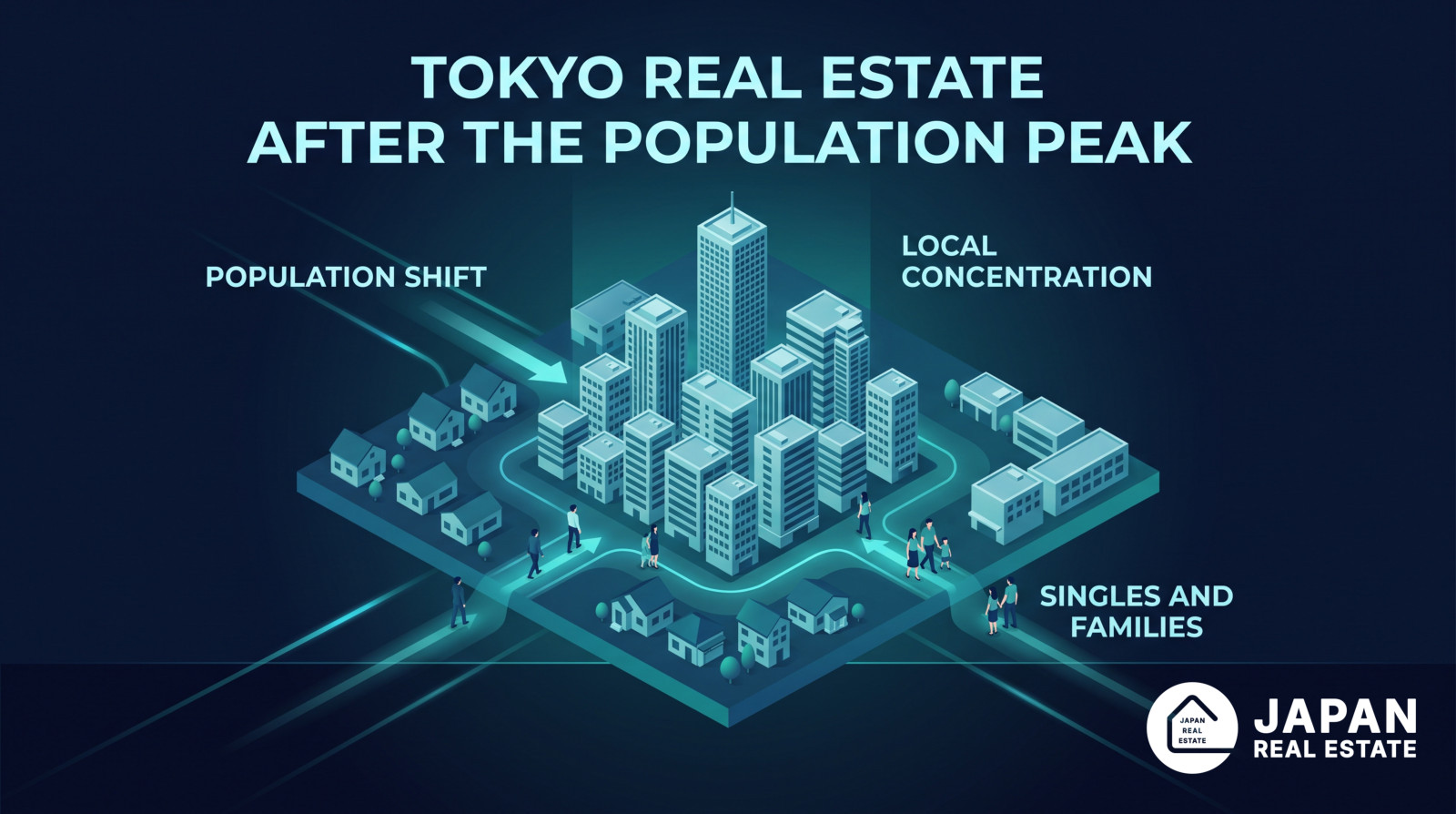
This is because the domestic population influx from regional areas to major metropolitan areas, especially Greater Tokyo, continues unabated, leading to a notable phenomenon of "localized concentration" where demand converges on specific areas. In this article, we explain to overseas investors the future demographic dynamics in the Greater Tokyo Area, rental demand forecasts for single and family households, and the ongoing "bipolarization" within the market, accompanied by detailed data and cultural context.
The Mechanism of Population Peak-Out and "Localized Concentration"
While Japan's total population is considered to have peaked around 2008, the influx of people into the Greater Tokyo Area—and Tokyo in particular—continued long afterward. According to projections by the National Institute of Population and Social Security Research, even as Japan's total population decreases, Tokyo's population is expected to remain high or slightly increase into the 2030s.
Behind this phenomenon lies the extreme concentration of economic activity and educational institutions in Tokyo. The trend of young people nationwide moving to the capital region for higher education or employment remains unchanged today. Furthermore, recent shifts in work styles and a stronger preference for living close to work (known as shokuju-kinsetsu—shortening commute times to enrich personal life) have accelerated this localized concentration into central Tokyo and around major, well-connected transit hubs.
When foreign investors invest in Japanese real estate, understanding this trend of localized concentration is essential. While the media occasionally covers the issue of vacant homes (akiya) across Japan, these instances primarily occur in regional cities or poorly accessible suburbs. In contrast, prime areas of Greater Tokyo experience the exact opposite dynamic: severe housing shortages and upward pressure on rents.
Shifts in Household Structures: Dynamics of Single and Family Households
Beyond overall population dynamics, changes in household structure also have a profound impact on rental demand. Here, we analyze future demand across two key segments: single households and family households.
Overwhelming Rental Demand from Single Households
The most noteworthy demographic metric in the Greater Tokyo Area is the increase in single-person households. According to Tokyo household projections, single households already account for more than 50% of all households in Tokyo, and this figure is expected to remain elevated over the long term. This trend is driven by socio-cultural shifts unique to Japan, such as later marriage, rising rates of non-marriage, and an increasing number of single elderly households.
Single residents generally prioritize commute convenience and surrounding neighborhood amenities (such as access to convenience stores, dining, and commercial facilities). As a result, studio and compact apartments (ranging from 1K to 1LDK) with convenient access to central Tokyo boast exceptionally resilient rental demand. For overseas investors, compact units catering to singles represent an attractive asset class offering short vacancy periods and stable income gains (rental revenue).
Rental Demand and Lifestyle Changes Among Families
On the other hand, notable changes are also occurring among family households. In the past, the standard Japanese life path was to "get married, have children, and purchase a detached house in the suburbs." Today, however, there is a rising number of high-earning dual-income households, commonly referred to as "power couples." To minimize commute times and balance childcare with demanding careers, these households tend to prefer renting highly functional condominiums in or near central Tokyo.
Nevertheless, with central Tokyo real estate prices soaring, some families seeking more living space are turning their attention to major commuter hubs in Kanagawa, Saitama, and Chiba Prefectures. In particular, the widespread adoption of remote work has increased the number of families who feel that "if commuting is only required a few times a week, a spacious home in a greener suburban setting is preferable." Consequently, rental demand for 2LDK to 3LDK family units has surged around terminal stations in Kanagawa, Saitama, and Chiba offering direct transit into central Tokyo. Because family tenants tend to reside in a property for extended periods once settled, these units offer the advantages of lower tenant turnover risk and highly stable asset management.
Sub-Market Forecasts and the Accelerating "Bipolarization" in Greater Tokyo
While demand remains robust across Greater Tokyo as a whole, not every area is guaranteed to succeed. The most critical keyword to bear in mind for future real estate investment is "bipolarization" (market divergence).
Tokyo: Unrivaled Brand Power and Persistent Influx
Tokyo's 23 wards—especially the central wards (such as Minato, Shibuya, Shinjuku, Chiyoda, and Chuo)—boast overwhelming brand prestige and convenience, continuously attracting demand from both singles and families. Rental rates remain high, offering world-class stability from an asset value preservation perspective. However, because property acquisition prices are also elevated, gross yields tend to be lower.
Kanagawa, Saitama, and Chiba: Stark Divergence Driven by Accessibility
In the three prefectures adjacent to Tokyo—Kanagawa, Saitama, and Chiba—market bipolarization is clearly visible. For example, areas within walking distance of major terminal stations offering a 30- to 45-minute direct commute to central Tokyo—such as Yokohama and Kawasaki in Kanagawa, Urawa and Omiya in Saitama, or Funabashi and Kashiwa in Chiba—continue to see population inflows and rising rent levels.
Conversely, even within the same prefectures, areas that require a long bus ride from the nearest station or have poor accessibility to central Tokyo are experiencing marked population decline and aging demographics. In such locations, vacancy risks rise dramatically, and owners face a high probability of entering price-cutting competition. Overseas investors seeking opportunities in the Greater Tokyo suburbs must keep this bipolarization in mind and carefully select competitive properties, such as those situated within a 10-minute walk from a station.
If you are looking for specific investment opportunities tailored to local market characteristics, please explore our Property Listings to discover assets in high-demand areas.
Japanese Rental Culture and Risks Overseas Investors Must Understand
When entering the Japanese real estate market, it is essential to understand Japan's unique leasing culture and legal framework alongside its demographic trends.
Tenant Protection Under the Act on Land and Building Leases
Japanese law (specifically the Act on Land and Building Leases) provides strong protections for tenant rights. Landlords cannot unilaterally terminate a lease or demand eviction without "justifiable grounds." While this presents the risk that dealing with non-compliant tenants can take time, it also serves as the foundation for high occupancy stability: once a tenant moves in, they tend to stay long-term. Family households and elderly singles in particular exhibit high retention rates, meaning that securing quality tenants effectively mitigates vacancy risk over the long haul.
The Critical Importance of Property Management for Asset Value
Even in areas benefiting from localized population influx, properties that suffer from inadequate maintenance and management will lose prospective tenants to newer or better-maintained competing developments. In Japan, cleanliness and modern amenities (such as delivery parcel boxes, free Wi-Fi, auto-lock security, and video intercoms) are heavily valued by tenants. For investors managing properties remotely from abroad, establishing a partnership with a trusted Japanese property management company—capable of handling everything from tenant acquisition and daily maintenance to post-move-out restoration—is an indispensable prerequisite for success.
Conclusion: Looking Past Macro Pessimism to Target Micro Demand
Judging solely by macro headlines proclaiming a "population peak-out," the Japanese real estate market might appear unappealing at first glance. However, when examining Greater Tokyo through a micro-level lens, one discovers rock-solid rental demand.
- Heightened demand in central Tokyo and around major transit hubs driven by "localized concentration" of economic activity and population
- Resilient demand for compact units tailored to "single" households amid later marriages and aging demographics
- Strong demand for suburban terminal station locations from "power couples" and space-conscious "families"
- Pronounced "bipolarization" emerging between transit-accessible locations and poorly connected areas
By correctly understanding these trends and executing data-driven sub-market selection, overseas investors can capture stable, long-term returns from Greater Tokyo's real estate market. In an era of increasing market divergence, identifying the areas where genuine demand converges is the key to building a resilient, high-performing portfolio.