
Why Invest in Japanese Real Estate?
Japan has become a premier destination for global real estate investors. Unlike many Asian and Western countries, Japan imposes zero restrictions on foreign property ownership. You can own both the building and the freehold land outright, exactly as a Japanese citizen would. Combined with a historically weak yen, the current market offers unprecedented purchasing power for overseas cash buyers.
However, the procedures and legal frameworks differ significantly from those in the US, UK, or Australia. This guide explores the practical procedures of Japanese real estate investment—focusing exclusively on cash transactions—and compares them with global standards.
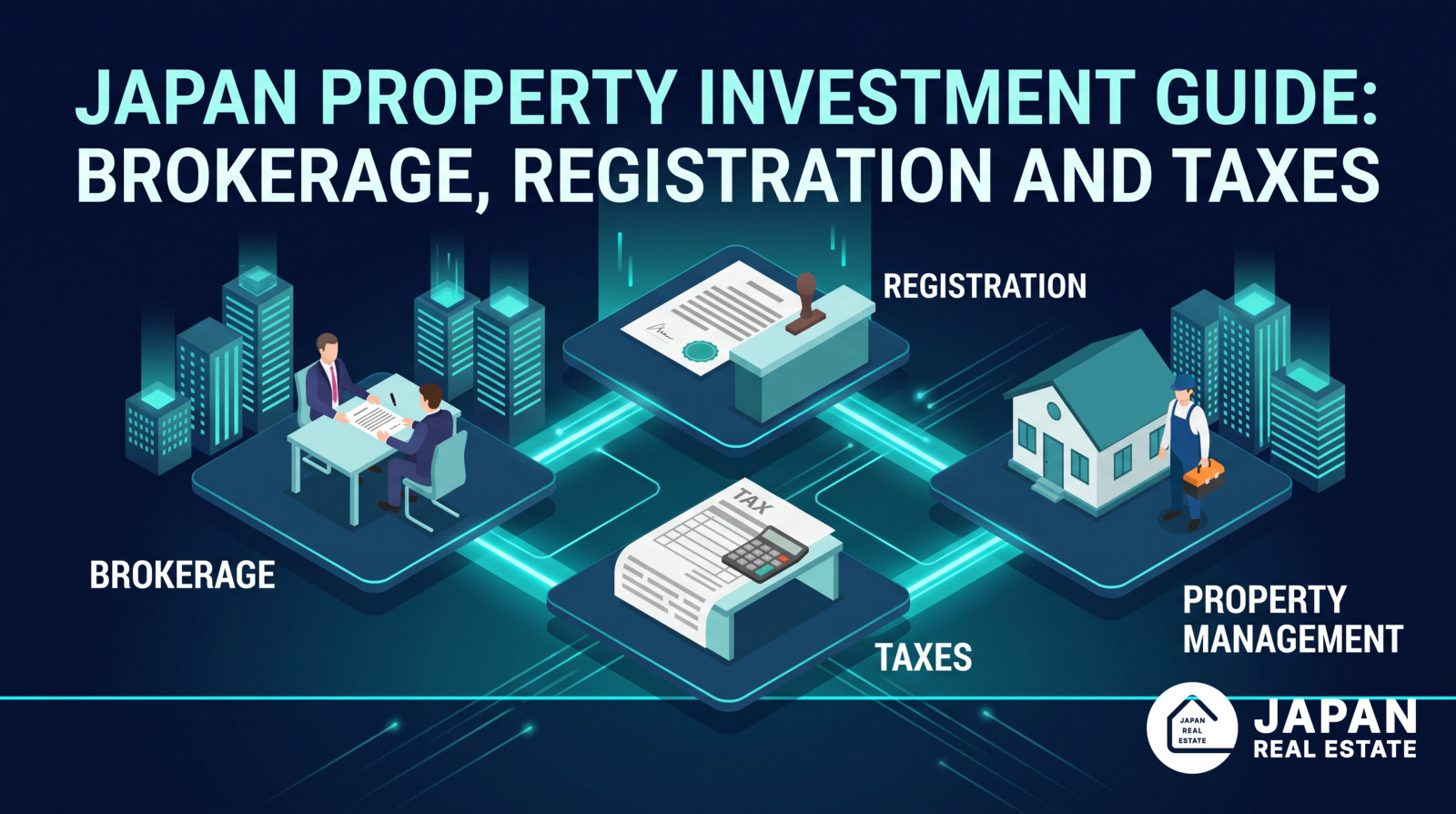
Real Estate Brokerage (Purchase)
In many Western countries, the buyer’s agent and seller’s agent are strictly separated by law. In Japan, the real estate brokerage (purchase) process can involve either a single agent representing both parties (dual agency) or separate agents. Dual agency is legal and common, but it is strictly regulated to ensure absolute fairness.
The Brokerage Fee Structure
Japanese brokerage fees (Chukai Tesuryo) are capped by law, providing a level of transparency that foreign investors appreciate. For properties priced over 4 million JPY, the maximum legal fee is calculated as:
- (Purchase Price × 3%) + 60,000 JPY + 10% Consumption Tax
For example, on a 50 million JPY cash purchase, the maximum brokerage fee is 1,560,000 JPY plus tax (approx. 1,716,000 JPY total).
The "Important Matter Explanation"
A unique cultural and legal aspect of the Japanese brokerage process is the Juyo Jikou Setsumei (Explanation of Important Matters). Before any binding contract is signed, a licensed Real Estate Notary (Takken-shi) must verbally explain a highly detailed legal document covering zoning laws, management fees, boundary disputes, and structural details. This rigorous consumer protection step significantly reduces post-purchase litigation compared to Western markets.
Ready to explore available opportunities? Browse our curated Property Listings to find your ideal investment.
Real Estate Registration (Transfer of Ownership)
In the US, buyers typically purchase Title Insurance to protect against ownership disputes. In Japan, Title Insurance does not exist. Instead, the country relies on a highly accurate, government-managed registry system.
The Role of the Judicial Scrivener
For real estate registration (transfer of ownership), you must use a Shihoshoshi (Judicial Scrivener). This licensed legal professional acts as a neutral third party who verifies the identities of the buyer and seller, ensures the cash funds have been fully transferred, and immediately registers the title change at the Legal Affairs Bureau.
Because Japan's registry system is public and meticulously maintained, the risk of title fraud is exceptionally low. The Judicial Scrivener's fee usually ranges from 50,000 to 150,000 JPY, depending on the property's assessed value and complexity. This one-time fee is often much cheaper than Western title insurance premiums.
Entrusting Property Management
For overseas investors, entrusting property management to a local firm is not just recommended; it is practically mandatory. Japan has unique cultural norms regarding renting, and the Act on Land and Building Leases heavily favors the tenant. Evicting a tenant for non-payment can take 6 to 12 months and requires formal court intervention.
What Japanese Property Managers Do
To mitigate these risks, Japanese property management companies perform rigorous tenant screening, almost always requiring tenants to use a Guarantor Company (Hosho Gaisha). If the tenant defaults, the guarantor company pays the rent, ensuring the investor's cash flow remains uninterrupted.
Property management outsourcing typically costs between 3% and 5% of the monthly gross rent. This fee is highly competitive globally (compared to 8-12% in the US or UK) and includes:
- Rent collection and international remittance
- Handling tenant inquiries and complaints (overcoming language and cultural barriers)
- Arranging repairs and maintenance
- Managing lease renewals and move-out inspections
Real Estate Taxes (Acquisition, Holding, Renting, Selling)
Understanding real estate taxes (acquisition, holding, renting, selling) is vital for calculating your true Return on Investment (ROI). Below is a breakdown of the tax obligations for non-resident cash investors.
1. Acquisition Taxes
When you purchase a property, you are liable for one-time taxes:
- Real Estate Acquisition Tax: Typically 3% for land and residential buildings, and 4% for commercial properties. This is calculated on the government-assessed value, which is usually 50-70% of the market price, not the purchase price.
- Registration License Tax: Usually 1.5% to 2% of the assessed value for transferring ownership.
- Stamp Duty: A fixed fee based on the contract price (e.g., 10,000 JPY for a 50 million JPY property).
2. Holding Taxes
As an owner, you will pay annual taxes based on the property's assessed value:
- Fixed Asset Tax: 1.4% annually.
- City Planning Tax: 0.3% annually (applicable if the property is located in a designated urban area).
Note for Non-Residents: You must appoint a local Tax Representative (Nozei Kanrinin)—often your property manager or an accountant—to receive and pay these tax bills on your behalf.
3. Renting Taxes (Income Tax)
Rental income generated in Japan is subject to Japanese income tax. For non-residents, if the tenant is a corporation, they are required to withhold 20.42% of the gross rent and pay it to the tax office. However, by filing an annual tax return in Japan, investors can deduct expenses (management fees, depreciation, property taxes) and often receive a substantial refund of this withheld amount.
4. Selling Taxes (Capital Gains)
When you decide to exit your investment, capital gains tax is levied on your net profit. Japan heavily incentivizes long-term holding through its tax brackets:
- Short-Term Capital Gains (held for 5 years or less as of Jan 1st of the selling year): 39.63%
- Long-Term Capital Gains (held for more than 5 years): 20.315%
Furthermore, if you are a non-resident selling a property for over 100 million JPY, or selling to a corporate buyer, the buyer must withhold 10.21% of the purchase price and pay it to the government. This acts as an advance payment of your capital gains tax, and any overpayment can be reclaimed by filing a final tax return.
Conclusion
Investing in Japanese real estate as a cash buyer offers tremendous potential, shielded by robust consumer protection laws, highly accurate property registries, and efficient property management services. While the taxation system requires careful navigation, the transparency and stability of the market make it a top-tier choice for global portfolios.
To begin your investment journey and view properties that match your financial goals, please visit our Property Listings.