
The Appeal of the Japanese Real Estate Market and Natural Disaster Risks Faced by Overseas Investors
The Japanese real estate market continues to attract keen interest from global investors, driven by its economic stability, transparent legal framework, and recent currency advantages (a weaker yen). In particular, all-cash transactions that do not rely on financing offer significant advantages, such as speedy closings and higher competitiveness when securing prime properties.
However, one factor that cannot be overlooked when investing in Japanese real estate is natural disaster risk. While Japan is blessed with rich natural landscapes, its geographical and climatic conditions make it prone to natural disasters such as earthquakes and typhoons.
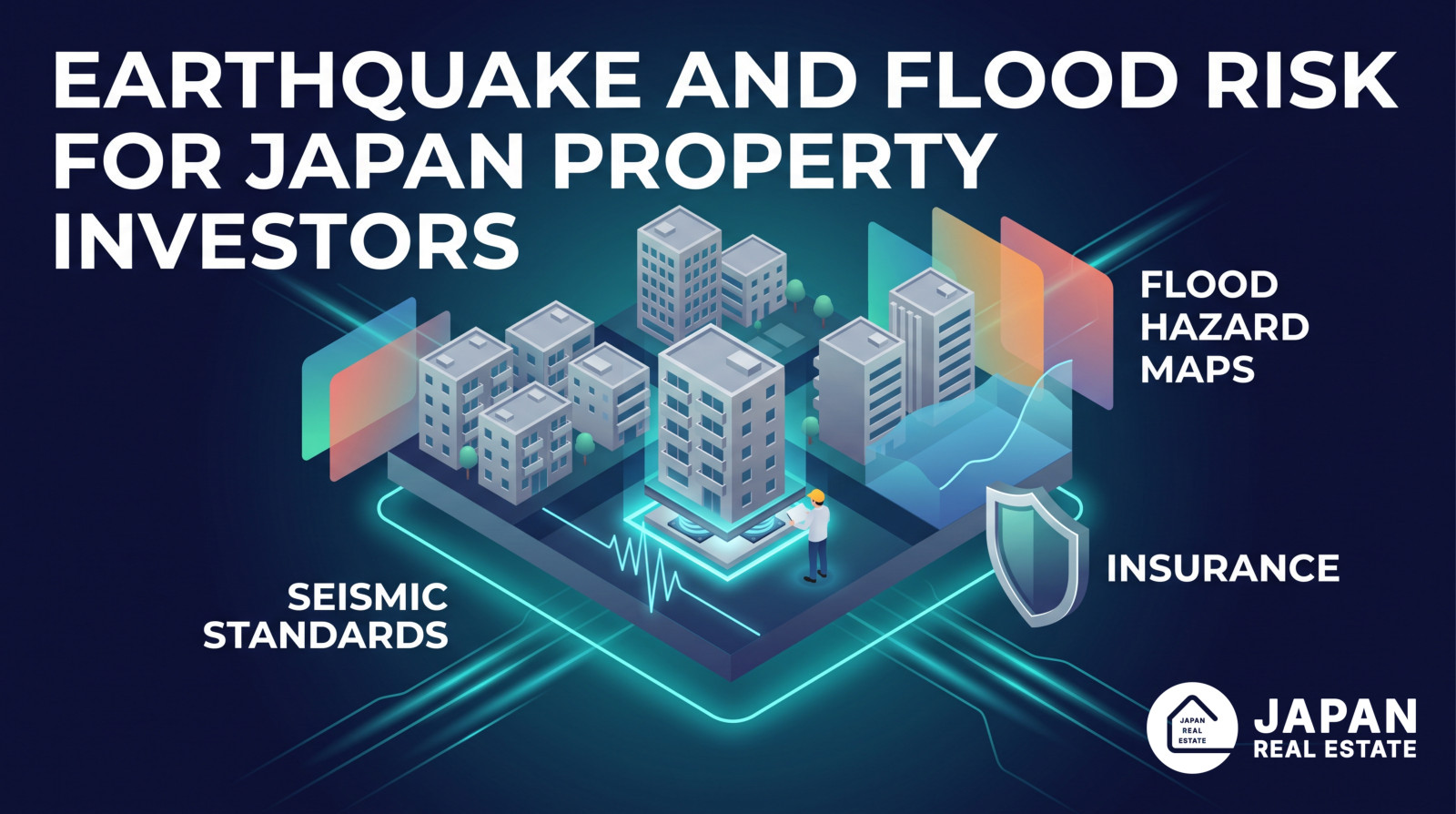
This article provides a detailed guide on how overseas investors can safely invest in Japanese real estate and protect their assets over the long term through effective earthquake and flood risk management.
The Biggest Concern in Japan Real Estate: Earthquakes and Japan's Seismic Standards (Old, New, and the Latest)
While Japan is one of the most earthquake-prone countries in the world, it is also home to world-class construction technology and stringent building regulations. Understanding Japan's seismic standards (both old and new, as well as the latest amendments) is the single most critical step in evaluating properties.
The Difference Between the Old and New Seismic Standards (The 1981 Milestone)
Japan's Building Standards Act has been updated multiple times based on lessons learned from major past earthquakes. The most crucial date every investor should know is June 1, 1981.
- Old Seismic Standards (Prior to May 31, 1981): Designed to prevent buildings from collapsing or crumbling during an earthquake with a seismic intensity of around Upper 5 on the Japanese shindo scale. Provisions for major earthquakes measuring intensity 6 or higher were not clearly defined.
- New Seismic Standards (From June 1, 1981 onward): Mandated that buildings must not collapse or suffer structural failure even during major earthquakes of intensity Upper 6 to 7, and should sustain minimal damage during tremors around intensity Upper 5.
Data from the 1995 Great Hanshin-Awaji Earthquake demonstrated that buildings constructed under the New Seismic Standards suffered dramatically less damage compared to those built under the Old Standards, proving their effectiveness.
Further Reinforcement Under the Latest Seismic Standards (The 2000 Standards)
In June 2000, the Building Standards Act was amended again, significantly strengthening the requirements for wooden structures in particular. This is known as the current "2000 Standards."
Key enhancements introduced in the 2000 Standards include:
- Mandatory Soil and Ground Surveys: Conducting a soil investigation prior to construction became virtually mandatory, requiring foundation designs (such as mat/raft foundations) tailored to the ground's load-bearing capacity.
- Balanced Placement of Shear Walls: Calculating the eccentricity ratio became mandatory to ensure a balanced distribution of load-bearing walls, preventing buildings from twisting and collapsing under seismic forces.
- Designation of Joint Metal Hardware: Specific types of metal connectors (such as hold-down hardware) were designated for connecting pillars, beams, and foundations, enhancing resistance against structural pull-out forces.
When foreign investors purchase properties in cash, it is essential not merely to judge a property by its age, but to verify which generation of seismic standards it complies with in order to safeguard long-term asset value.
Rising Risks of Typhoons and Flooding Due to Climate Change
In recent years, global climate change has shifted the patterns of natural disasters in Japan. Investors must pay close attention to the increasing risk of flooding caused by larger typhoons and localized torrential downpours.
Current Trends in Typhoons and Torrential Rains
According to data from the Japan Meteorological Agency, the annual frequency of "extremely heavy rain" (50 mm or more per hour, often described as waterfall-like rain) has increased by approximately 1.5 times over the past 40 years. As a result, urban areas are increasingly susceptible to "inland flooding" (pluvial flooding), where rainwater exceeds the drainage capacity of sewer systems, as well as large-scale river inundations.
In real estate investment, even if a building's structure is resilient, ground-floor flooding can cause substantial repair expenses and tenant displacement, resulting in lost rental income.
Essential Tool: Selecting Locations Using Hazard Maps
To mitigate flood risks, utilizing the "Flood Hazard Maps" published by local municipalities across Japan is essential. Hazard maps use historical data and topography to illustrate anticipated damage zones and designated evacuation areas.
When evaluating prospective investment locations, review the following points on the hazard map:
- Flood Inundation Depth: The estimated depth of floodwaters if nearby rivers overflow (e.g., under 0.5 meters, over 3.0 meters, etc.).
- Storm Surge & Tsunami Risks: For coastal properties, assess the risk of storm surges from typhoons or tsunamis triggered by earthquakes.
- Landslide Warning Areas: For properties near hillsides or mountainous terrain, verify whether there is a risk of slope failure or debris flows.
Because cash buyers do not undergo bank collateral appraisals, the responsibility falls on the investor (or their trusted real estate agent) to interpret hazard maps and identify safe locations.
Implementing Risk Management for Earthquakes and Floods via Fire Insurance
No matter how seismically sound a building is or how safe the location appears on a hazard map, natural disaster risks cannot be reduced to zero. This makes risk management through comprehensive fire insurance vital.
The Unique Structure of Japanese Fire and Earthquake Insurance
The Japanese insurance system has a specific rule that overseas investors must understand: standard fire insurance does not cover damages caused by earthquakes, volcanic eruptions, or resulting tsunamis.
To protect against fire or structural collapse caused by an earthquake, you must add "Earthquake Insurance" to your fire insurance policy. Earthquake insurance is a public-private program jointly operated by the Japanese government and non-life insurance companies; premiums and coverage terms are standardized across all providers. However, note that the maximum coverage limit is capped at 50% of the fire insurance insured amount.
Covering Flood Risks with "Water Damage Coverage"
Damages from river floods, heavy rainfall inundation, and landslides caused by typhoons or torrential rain can be covered by adding a "Water Damage Coverage" rider to your base fire insurance policy.
If purchasing a high-floor condominium unit (e.g., 3rd floor or above), the risk of above-floor flooding is minimal, allowing investors to opt out of water damage coverage to save on premiums. However, for detached houses, ground-floor commercial spaces, or low-floor residential units, water damage coverage is strongly recommended.
Because all-cash buyers do not carry mortgages, purchasing property insurance is not legally mandatory. However, since you are committing 100% of your own capital, securing proper fire and earthquake insurance is an essential hedge against total loss.
Actionable Risk Mitigation Steps for Overseas Investors
To achieve long-term success in the Japanese property market, property selection must account for disaster resilience alongside yield and design:
- Verify Seismic Standards: Prioritize properties built under the post-1981 New Seismic Standards, or ideally, the post-2000 Latest Standards.
- Conduct Site Due Diligence: Review municipal flood hazard maps and prioritize locations with minimal flood and landslide risks (e.g., elevated ground).
- Structure Comprehensive Insurance: Upon closing, put in place a robust financial hedge by combining fire insurance with earthquake insurance and water damage coverage as appropriate.
An efficient way to discover quality investment properties that meet these criteria is through a trusted real estate portal. Explore our carefully curated Property Listings to find the ideal Japanese real estate opportunity for your investment portfolio.
Conclusion
When managed properly, Japanese real estate investments offer remarkably stable and attractive returns. While climate-related risks and earthquakes are realities in Japan, they can be effectively controlled by understanding seismic building standards, leveraging flood hazard maps for location due diligence, and establishing comprehensive insurance coverage.
Leverage your strengths as a cash investor—swift decision-making and efficient execution—while building a resilient, well-protected investment strategy.