
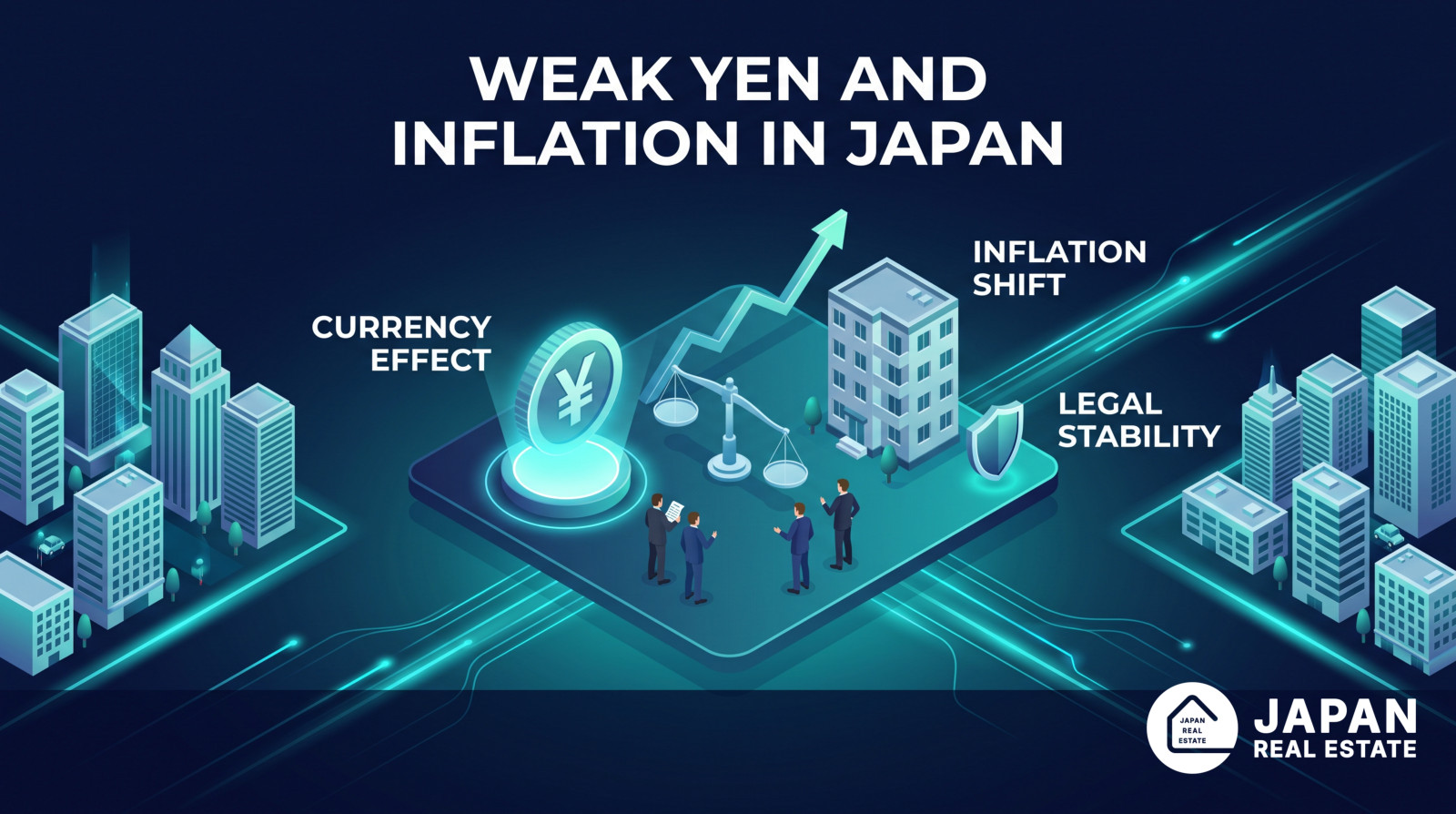
Investors worldwide are turning their keen attention to the Japanese real estate market. Emerging from decades of economic stagnation once known as the "Lost 30 Years," Japan's real estate sector is now experiencing unprecedented opportunities.
In this article, we provide an in-depth guide for overseas investors on why now is the ideal time to invest in Japanese real estate, covering macroeconomic factors, legal advantages, and the immense competitive edge of cash purchases.
If you are looking for premier investment opportunities, please explore our Property Listings.
5 Reasons Why Now Is the Prime Timing for Japan Real Estate Investment
1. Massive Discount Effect Driven by the "Historically Weak Yen"
You cannot discuss today's Japanese real estate market without highlighting the historically weak Japanese Yen (JPY). While the exchange rate was in the 80 JPY per 1 USD range in the early 2010s, it currently fluctuates between 140 and 150 JPY per USD. Viewed from foreign currency terms, Japanese real estate is virtually on a massive discount sale.
Let's look at a comparison when purchasing a ¥100,000,000 property:
| Exchange Rate | Approximate USD Price for a ¥100M Property | Impact on Investors |
|---|---|---|
| 1 USD = 100 JPY | Approx. $1,000,000 USD | Standard baseline pricing |
| 1 USD = 150 JPY | Approx. $666,666 USD | Approx. 33% Discount |
For overseas investors holding strong currencies such as USD, EUR, or SGD, simply converting cash funds into JPY offers substantial foreign exchange savings and capital efficiency.
2. "Japanese Economy Pivoting from Deflation to Inflation"
Having endured prolonged deflation with stagnant or falling prices, Japan is now undergoing a historic paradigm shift: the transition from deflation to sustainable inflation.
The Consumer Price Index (CPI) shows steady upward trends, and Japanese corporations are actively raising wages. During inflationary periods, the purchasing power of cash diminishes, whereas hard assets like real estate serve as powerful inflation hedges as property values and rental incomes rise alongside general price levels. Rents in central metropolitan areas have already begun rising, fueling strong expectations for growing yields and higher income gains in the future.
3. "Rising Property Prices" Centered Around Major Metropolitan Areas
The Japanese real estate market is demonstrating a distinct trend of rising property values, particularly in prime metropolitan centers such as Tokyo, Osaka, Kyoto, and Fukuoka.
According to data from the Real Estate Economic Institute, the average price of newly built condominiums across Tokyo's 23 wards has surpassed the ¥100 million mark. Pre-owned condominium prices have also experienced over a decade of continuous upward momentum. When compared to global gateway cities like New York, London, Hong Kong, or Singapore, Tokyo real estate remains relatively undervalued, leaving ample room for long-term capital gains upon future exit.
4. Notably, "Japan Imposes No Restrictions on Foreign Property Ownership"
One of the most compelling advantages for international investors is that Japan allows unrestricted real estate ownership by foreigners.
Many major global real estate markets impose stringent regulations and heavy surcharges on foreign buyers:
- Singapore: Imposes hefty Additional Buyer's Stamp Duty (ABSD) on foreign residential buyers.
- Australia / Canada: Have restrictions or bans on foreign purchases of established dwellings, along with vacancy taxes and foreign buyer surtaxes.
- China / Southeast Asia: Land is often state-owned, restricting foreigners to leasehold rights only.
In Japan, however, foreign buyers can acquire complete freehold ownership under the exact same terms as Japanese citizens. There are no visa or residency requirements, nor are there punitive taxes targeting foreigners. This open framework makes Japan an exceptionally rare and favorable global investment environment.
5. High "Legal Stability of Rights" and Minimal Country Risk
When investing in real estate abroad, the reliability of the host nation's legal system is critical. Operating under a robust rule of law, Japan offers an exceptionally high level of legal stability for property rights.
The Legal Affairs Bureau oversees a stringent real estate registration system that provides ironclad protection for ownership titles. With stable political conditions, country risk—such as expropriation or sudden policy reversals targeting foreign assets—is practically non-existent. As a premier safe haven asset, Japanese real estate continues to be favored by high-net-worth individuals worldwide.
Cultural Insights and Risk Management for Foreign Investors
While the Japanese property market offers lucrative opportunities, navigating unique local business practices is essential for successful execution.
The Formidable Advantage of Cash Buyers
Japanese domestic financial institutions rarely grant mortgages or investment loans to non-resident foreign nationals without permanent residency. Consequently, most international investors purchase properties using equity capital (full cash payment).
In reality, being an all-cash buyer is the most potent advantage in Japan's real estate market. Japanese sellers—particularly individual owners—prioritize transaction certainty and speed above all else. A cash buyer eliminates the risk of contract cancellation due to loan rejection (loan contingency cancellation clauses), making them the preferred counterparty for sellers. Even in competitive scenarios with multiple offers, cash buyers frequently secure properties preferentially and gain superior leverage during price negotiations.
Local Transaction Process and Contractual Practices
Real estate transactions in Japan follow a structured procedure:
- Submission of Purchase Application (Letter of Intent): Submitting formal intent and proposed price in writing (specifying cash terms).
- Explanation of Important Matters (IT / Online Delivery Available): A nationally licensed Real Estate Transaction Specialist delivers an extensive briefing regarding legal titles, building restrictions, and potential risks. This can be conducted remotely online.
- Contract Execution & Earnest Money Deposit: Paying approximately 5% to 10% of the purchase price as a deposit upon signing the sales contract.
- Final Settlement & Handover: Under the supervision of a licensed Judicial Scrivener (registration specialist), the remaining balance is settled and the title transfer is executed simultaneously.
Because international bank transfers require rigorous anti-money laundering (AML) clearances that may take several business days to credit, it is vital to coordinate remittance schedules closely with your real estate agency.
Investment Simulation: Cash Purchase Model in Central Tokyo
Here is a simplified simulation of purchasing a pre-owned condominium in central Tokyo as an all-cash investment:
- Target Asset: Pre-owned condominium in Central Tokyo (e.g., Minato-ku, Shibuya-ku)
- Purchase Price: ¥100,000,000 (100% Cash Settlement)
- Acquisition Expenses: Approx. ¥7,000,000 (Brokerage fees, registration taxes, acquisition taxes, etc.)
- Estimated Annual Gross Rental Income: ¥4,500,000 (Gross Yield: 4.5%)
- Annual Operating Expenses: Approx. ¥1,000,000 (HOA management fees, repair reserve fund, property taxes, property management fees, etc.)
【Net Yield Calculation】
- Annual Net Operating Income (NOI) = ¥4,500,000 - ¥1,000,000 = ¥3,500,000
- Net Yield = ¥3,500,000 ÷ (¥100,000,000 + ¥7,000,000) ≒ 3.27%
In addition to securing attractive and stable rental cash flows compared to other global tier-1 cities, capitalizing on current inflationary dynamics and property appreciation provides significant potential for capital gains over a 5 to 10-year holding period.
Conclusion: Why You Should Take Action Today
The compelling valuation created by the historically weak Yen, the growth momentum from Japan's transition to inflation, and steady property price appreciation combine to create a remarkable market window. Add to this Japan's unrestricted freehold ownership for foreign investors and world-class legal certainty, and you have an unparalleled global investment environment.
International investors capable of moving swiftly with cash occupy a privileged position to acquire Japan's prime properties under the most advantageous terms. As currency valuations and property prices constantly evolve, now is the ideal time to seize this historic opportunity.
To discover prime properties and review comprehensive market data, visit our Property Listings to find the perfect Japanese real estate assets for your investment portfolio.