Introduction: The Appeal of Earning Passive Income from Japanese Real Estate from Abroad
The Japanese real estate market, particularly properties in Tokyo, continues to attract strong interest from international investors worldwide. The primary reasons include an exceptionally stable political and economic foundation, world-class public safety, and highly developed infrastructure. Combined, these elements make Tokyo one of the premier markets globally for securing stable, long-term passive income.
However, managing a Japanese real estate portfolio remotely while living overseas presents unique challenges. The language barrier, time zone differences, and Japan's distinct business practices are among the many hurdles investors must navigate. In this article, we provide an in-depth guide on property management in Japan for foreign investors seeking high yields, alongside key strategies for successful remote real estate management in high-demand Tokyo.
Obstacles Foreign Investors Face in Japanese Property Management
When operating and managing a Japanese real estate portfolio from abroad, international investors face several unique challenges. Gaining a deep understanding of Japan's distinctive culture and commercial customs beforehand is the critical first step toward long-term success.
Language and Cultural Barriers
Japanese remains the primary language of business across the domestic real estate industry. Lease agreements, Important Matters Explanation documents, monthly management reports, and tenant complaint resolutions are almost entirely handled in Japanese.
Furthermore, Japan has its own distinct rental customs:
- Security Deposit (Shikikin): Funds held in escrow to cover repair costs or unpaid rent when a tenant moves out.
- Key Money (Reikin): A non-refundable gratuity paid directly to the landlord upon signing the lease.
- Renewal Fee (Koshinryo): A fee paid by the tenant to the landlord upon contract renewal (typically every two years).
- Restoration to Original Condition (Genjo Kaifuku): The tenant's obligation to return the unit to its original move-in state upon departure.
Failing to accurately grasp these unique Japanese concepts risks miscommunication with tenants and local partners, potentially escalating into unexpected disputes.
Physical Distance and Time Zone Gaps
When managing properties remotely from abroad, time zone differences pose a significant operational hurdle. When urgent tenant issues arise—such as water leaks or equipment failures—delays in real-time decision-making due to time differences lead to tenant frustration. Declining tenant satisfaction can ultimately increase vacancy risks through move-outs; therefore, establishing a management framework that mitigates time zone friction is essential.
Three Keys to Successful Remote Real Estate Management in Tokyo
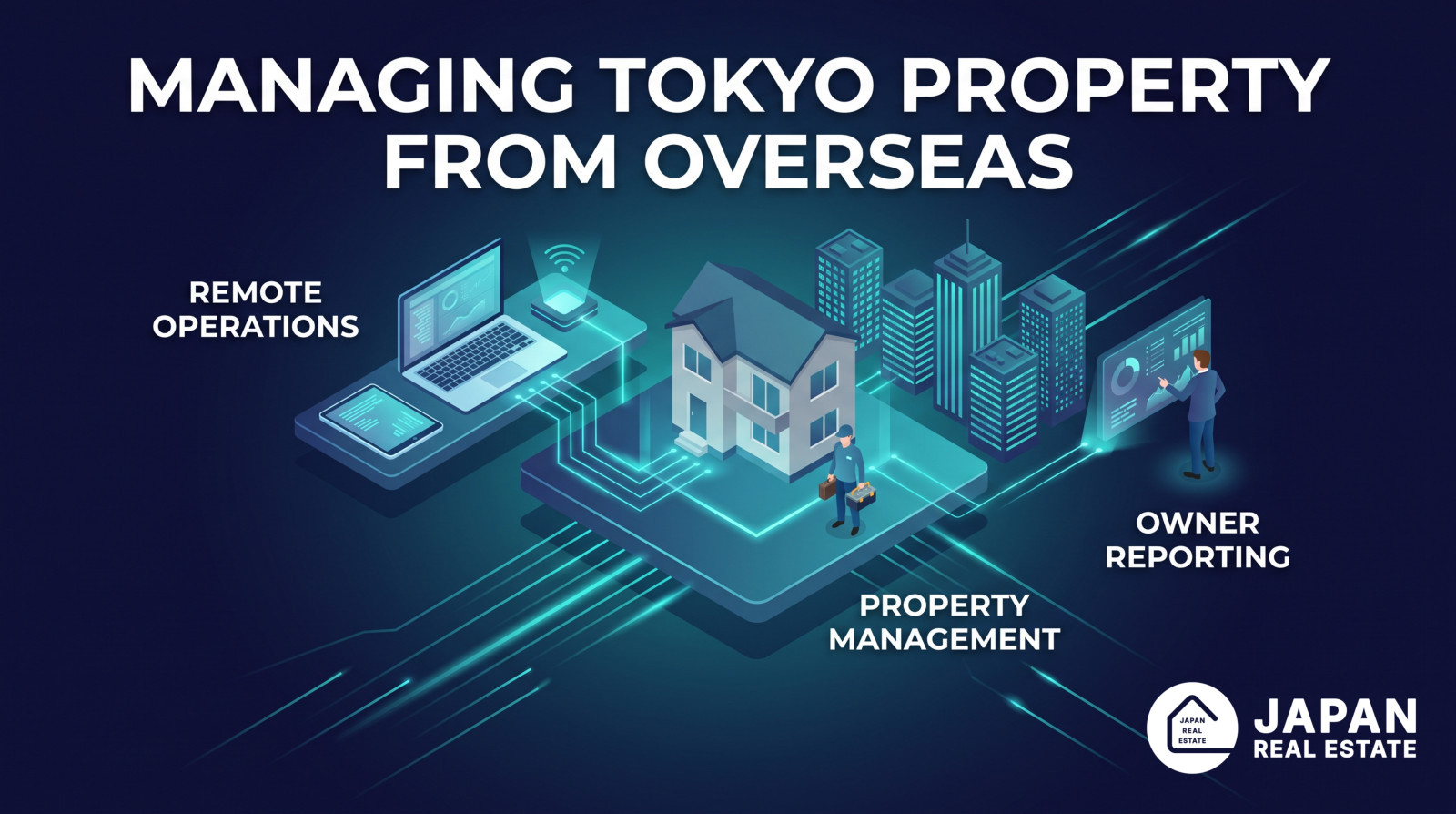
To bridge the physical distance and successfully manage properties remotely in major metropolises like Tokyo, choosing the right local partners and leveraging modern systems are paramount.
1. Selecting a Reliable Bilingual Property Management (PM) Company
In Japanese property management, a professional property management (PM) company serves as the eyes, ears, and hands of foreign investors. Selecting a management firm equipped with multilingual support in languages such as English and Chinese is an indispensable requirement. An exceptional PM company translates Japan's unique business customs into clear terms for investors, facilitates smooth tenant communications, and delivers around-the-clock support unaffected by time zone disparities.
2. Implementing Transparent Cloud-Based Management Tools
In modern remote real estate management in Tokyo, the adoption of PropTech directly influences investment performance. Choose a management company that provides a cloud platform where rental income track records, operating expenses, repair histories, and tenant lease statuses can be monitored in real time. This allows you to instantly track the health of your portfolio from overseas and make data-driven management decisions without delay.
3. Rapid Tenant Dispute Resolution and Preventive Maintenance
To preserve the asset value of your property over the long run, shifting from reactive problem-solving to proactive preventive maintenance is critical. Taking Japan's climate into account—such as hot, humid summers and the typhoon season—developing an annual maintenance schedule that includes air conditioner cleaning, high-pressure pipe flushing, and roof waterproofing inspections helps prevent sudden, costly outlays.
Portfolio Building Strategies for Generating Stable Passive Income
To achieve consistently high yields, meticulous property selection and thorough area analysis are indispensable.
The Appeal and Stability of the Tokyo Rental Market
Tokyo is a world-class megacity with a population of approximately 14 million, continuously drawing young professionals, single-person households, and international students from both across Japan and around the world. According to statistics from the Ministry of Internal Affairs and Communications, single-person households account for over 50% of households in Tokyo's 23 wards, maintaining robust demand for compact rental units such as studio (one-room) and 1K layouts. This resilient tenant demand serves as the bedrock of passive income.
Property Selection Criteria to Maximize Yields
Rental housing demand across Tokyo's 23 wards is consistently strong, and well-located properties rarely suffer from extended vacancies. You can explore currently available listings in our property listings. When selecting a property, consider the following benchmarks:
- Transit Accessibility: Within a 10-minute walk from the nearest train station (ideally within 5 minutes).
- Daily Conveniences: Supermarkets, convenience stores, and drugstores within walking distance.
- Amenity Requirements: Auto-lock security, delivery parcel lockers, and complimentary high-speed Wi-Fi (now considered essential amenities for single residents in Tokyo).
Rental Market Characteristics Across Major Tokyo Areas
| Area | Primary Target Tenant | Expected Occupancy Rate | Ease of Remote Management & Characteristics |
|---|---|---|---|
| Minato & Shibuya Wards | Executives, foreign expats, tech professionals | Extremely High | High rental rates with numerous high-end management firms offering English support. |
| Shinjuku & Toshima Wards | Students, young professionals, international students | High | Robust rental demand with short vacancy cycles; diverse international tenant base. |
| Shinagawa & Ota Wards | Families, frequent business travelers | Stable | Excellent transit access to Haneda Airport and the Shinkansen; long-term tenant tenures reduce turnover management. |
Risk Management and Countermeasures in Remote Operations
When managing Japanese real estate from abroad, controlling operational risks is fundamental to securing sustainable high yields.
Minimizing Vacancy Risk Through Strategic Leasing
The Japanese rental market features distinct peak seasons: primarily the spring window (February to March) before the start of the fiscal and academic year, and the autumn relocation season (September to October). Developing an agile leasing strategy that aligns lease terminations with these windows and calibrates offering terms (such as waiving key money or offering free rent) is vital.
Additionally, to facilitate remote overseas operations, introducing VR virtual tours and smart locks creates an environment where local brokerage agents can easily conduct showings, directly shortening vacancy periods.
Preventing Repair and Move-Out Disputes
Japan's Ministry of Land, Infrastructure, Transport and Tourism (MLIT) maintains official "Guidelines on Restoration to Original Condition and Associated Disputes." Under these guidelines, move-out repair cost allocations are clearly defined: natural aging and ordinary wear and tear are the responsibility of the landlord (investor), whereas intentional or negligent damage is borne by the tenant.
Foreign investors must thoroughly understand these baseline principles. To avoid settlement disputes upon lease termination, it is essential that your local management company comprehensively documents the unit's condition at move-in using high-resolution photos or videos and archives this evidence on a secure cloud platform.
Partnering with Tax and Legal Specialists
Real estate management extends beyond building upkeep and tenant relations. Appropriately filing tax returns in Japan on rental income earned domestically is an integral part of remote asset management. By partnering with a PM company that maintains an established network of bilingual licensed tax accountants and judicial scriveners experienced in foreign investor taxation, you can ensure compliant, secure, and stress-free operations.
Summary: Seamless Management of Your Japanese Real Estate Portfolio from Abroad
For international investors managing Japanese real estate, language barriers, physical distance, and cultural differences are undeniable factors. Yet, with a well-conceived strategy and a trustworthy local partner, managing Tokyo properties remotely from abroad can consistently generate rewarding yields and sustainable passive income.
By developing a sound grasp of Japan's rental customs and harnessing transparent cloud-based management platforms and modern technologies, your property portfolio can deliver steady returns over the long term. Stay attuned to current market dynamics and regional characteristics, explore compelling investment opportunities via our property listings, and build your ideal passive income stream in Japan today.