
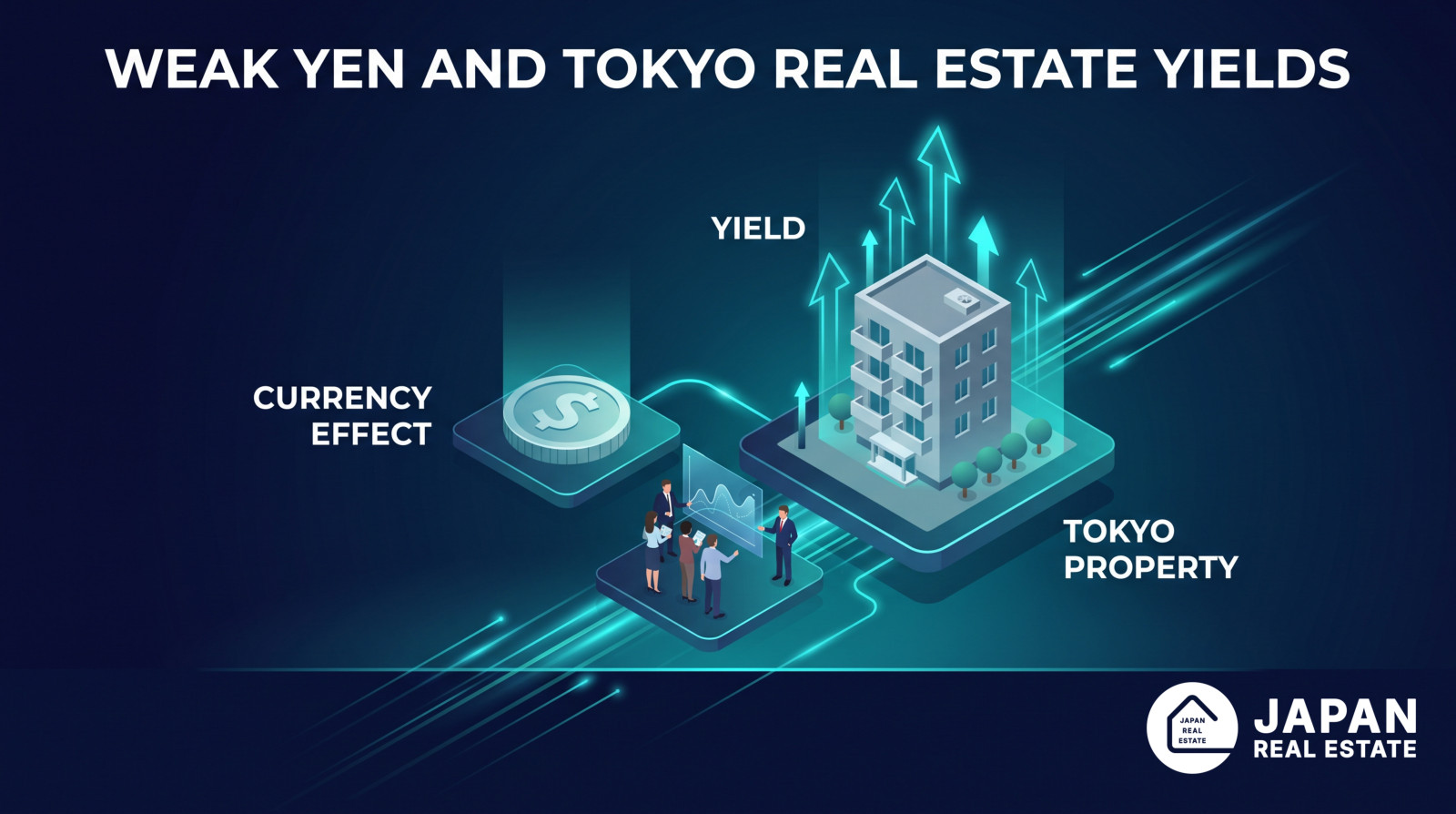
A Historic Tailwind for the Japanese Real Estate Market
The ongoing historic depreciation of the yen offers foreign-currency-denominated overseas investors an unprecedented opportunity to acquire prime Japanese real estate at exceptionally attractive prices. For example, compared to exchange rates just a few years ago, acquisition costs evaluated in major foreign currencies such as the US Dollar, Euro, or Singapore Dollar have decreased significantly.
This dramatic sense of value brought by the "weak yen" to "real estate investment" has drawn keen attention from institutional investors, family offices, and high-net-worth individuals worldwide, serving as the single largest driver accelerating capital inflow into Japan. In this article, we provide a detailed analysis of how foreign investors can maximize this currency advantage, explore unique market characteristics, and optimize the ROI (return on investment) of Japanese real estate—particularly in Tokyo.
Why Are Overseas Investors Focusing on Japanese Real Estate Right Now?
Beyond currency advantages, the intrinsic strengths of Japanese real estate continue to captivate overseas investors. The primary factors include:
1. Rare "Freehold Ownership" in Asia
In many Asian countries and regions (such as mainland China, parts of Singapore, and various Southeast Asian nations), land remains state-owned, meaning investors can typically only acquire leaseholds lasting several decades. In Japan, however, foreign nationals are entitled to acquire full "freehold ownership" of both land and buildings under the exact same conditions as Japanese citizens. This allows investors to preserve asset value across generations without worrying about lease expirations, while pursuing long-term capital appreciation.
2. Political and Economic Stability with Low Country Risk
Japan stands out as a constitutional state governed by the rule of law, boasting world-class political and economic stability. Country risks—such as asset expropriation via abrupt legal changes or market turmoil triggered by political unrest—are exceptionally low. In an era of escalating global uncertainty, Japanese real estate acts as a safe haven, substantially contributing to portfolio stabilization.
3. Highly Transparent Market and Mature Legal Framework
Japan's real estate market offers abundant transaction data and market research reports, earning it global recognition for high market transparency. With a well-established legal infrastructure and clear property rights protected by the official real estate registry system, investors can make decisions from abroad with confidence.
Strategies to Maximize ROI in Tokyo Real Estate
As the world's largest megacity, Tokyo continues to offer attractive yield spreads compared to other global peers such as New York, London, or Hong Kong. To maximize ROI in Tokyo real estate, a strategic approach addressing the following core areas is essential:
Optimizing Income Gain and Capital Appreciation
The Tokyo real estate market has traditionally excelled at delivering stable income gains (rental revenue). Occupancy rates for residential properties in central Tokyo are consistently high and vacancy risk is low, enabling predictable and reliable cash flows. Furthermore, driven by large-scale urban redevelopment projects across central districts and a swift rebound in inbound tourism, property values have been steadily rising in recent years. The market has evolved into one where investors can realistically capture medium- to long-term capital gains (sales profits). Balancing income and capital upside is key to maximizing overall ROI.
Location Selection and Clear Tenant Targeting
Even within Tokyo, tenant profiles and expected investment outcomes vary widely depending on the area. To enhance ROI, understanding neighborhood dynamics and defining clear target tenant demographics is critical.
| Area Category | Key Wards / Districts | Characteristics & Target Tenant Base | Expected Investment Performance |
|---|---|---|---|
| Central 5 Wards | Minato, Chiyoda, Chuo, Shinjuku, Shibuya | Domestic & global executives, high-net-worth individuals, multinational expats. Exceptional brand value. | High asset value retention, capital gains, stable premium rents |
| Jonan & Joshi Areas | Meguro, Shinagawa, Setagaya, Nakano, etc. | Outstanding transit convenience; widely favored by families and single professionals. | High occupancy rates, stable income gain, minimal vacancy risk |
| Major Redevelopment Zones | Toranomon, Takanawa Gateway, areas around Nihonbashi, etc. | Ongoing infrastructure upgrades and emerging business hubs. High future potential. | Future rental growth, substantial capital appreciation |
Advantages and Risk Management: Investing with a Weak Yen
Substantial Upside from Foreign Exchange Gains
Acquiring Japanese real estate under current weak yen conditions offers an opportunity to realize potential "forex gains" through future currency appreciation. Should the yen rebound toward historical norms at the time of asset liquidation or profit realization, investors stand to benefit from a dual profit engine: property appreciation compounded by foreign exchange upside (significantly boosting net ROI). This is an exclusive advantage available to foreign-currency-based investors.
Risk Management: Natural Disaster Preparedness and Rigorous Building Standards
When evaluating real estate in Japan, overseas investors frequently point to natural disaster risk, particularly earthquakes, as a primary concern. However, Japan's Building Standards Act is recognized as one of the most stringent in the world. Properties designed and constructed under the "New Anti-Seismic Design Standards" introduced in 1981, and reinforced by the revised standards of 2000, demonstrate outstanding earthquake resistance. By selecting assets of appropriate building vintage and utilizing municipal hazard maps to evaluate locations, this risk can be effectively controlled.
Demographics: Macro Decline vs. Micro (Tokyo) Expansion
While Japan's overall population is declining, real estate investment demands a "micro-level perspective." Influx into Tokyo—especially among young professionals and single-person households arriving for higher education and employment—continues unabated. Consequently, rental demand for single-occupant layouts (such as studio and compact apartments) in convenient areas across Tokyo's 23 wards is projected to remain resilient, providing a solid foundation for long-term ROI.
Cultural Background and Business Practices Overseas Investors Must Know
Japan's rental market features distinctive cultural conventions and commercial customs uncommon in other countries. Understanding and leveraging these practices is key to achieving success in Japanese real estate investment.
Yield Enhancement Through Key Money and Renewal Fees
In many parts of Japan, tenants pay the property owner non-refundable "Key Money (Reikin)" upon entering into a new lease. This payment typically equals one to two months' rent and is not returned when the tenant vacates. Additionally, lease renewal agreements (commonly every two years) frequently entail a "renewal fee." These funds represent pure supplemental income for owners, significantly bolstering effective net yields.
Eliminating Default Risk via Rent Guarantee Companies
Japan's Act on Land and Building Leases affords strong protections to tenants, making unilateral lease termination by landlords exceptionally difficult. However, in today's rental market, prospective tenants are almost universally required to enroll with an institutional "Rent Guarantee Company." Should a tenant fall behind on rent, the guarantee company advances the overdue payment directly to the owner, virtually eliminating the risk of cash flow disruption caused by rental default.
The Critical Role of Professional Property Management (PM)
Managing Japanese property directly from abroad is rarely feasible. To navigate language barriers, time zone differences, and local business practices, partnering with a dependable Japanese property management (PM) firm is indispensable. A capable PM partner handles tenant leasing, routine inquiry resolution, end-of-tenancy restoration, and regulatory compliance. Entrusting these functions to seasoned professionals directly impacts long-term asset value retention and ROI maximization.
Conclusion: Strengthening Your Portfolio with Japanese Real Estate Amid a Weak Yen
The ongoing historic depreciation of the yen offers international investors a rare window of opportunity to enter the real estate market of one of the world's largest, most stable economies under exceptionally favorable conditions.
By strategically selecting properties in high-demand hubs such as Tokyo, leveraging local commercial practices (such as key money and rent guarantee schemes), and mitigating operational risks through world-class structural resilience, investors can realize exceptionally compelling ROI. Adding resilient, yield-generating Japanese real estate to a global investment portfolio represents an effective move toward cross-border diversification and sustainable capital growth.
To explore appealing investment properties tailored for international investors and aligned with current market conditions, please review our Property Listings to find the asset that best fits your portfolio strategy.